Collector reference · Watches — F.P. Journe
F.P. Journe collecting guide: models, 2026 prices, and how to sell yours
Independent collector reference · prices are indicative secondary-market bands · reviewed June 2026 · figures are volatile and must be re-verified before any sale.
About this guide · how we value
Why you can trust these figures
Passion Asset Advisory is an independent private brokerage that values, places and sells F.P. Journe for collectors. We sit on both sides of these transactions — sourcing for buyers and selling for owners — so the bands here are read from pieces we watch change hands, not from listings alone. We represent one side of any single deal, hold no inventory, and are paid on the sale on a schedule agreed in writing: a conflict we disclose plainly, and the reason we will tell you to hold when holding is the right call. The bands are indicative secondary-market figures synthesised from current dealer and marketplace listings and recent public auction results at Phillips, Sotheby’s and Christie’s, read against the exact reference, generation (brass vs. gold), dial, case material, edition and condition. They are decision tools, not formal appraisals.
Reviewed June 2026 · independent of any dealer or auction house · for a reference-level figure on your own watch, request a confidential valuation.
Active mandate · as of June 2026
We are buying an F.P. Journe Élégante 48 mm Titalyt — full set
A funded private client is seeking one Élégante 48 mm Titalyt (Ref. ELHT) in new or like-new condition, complete with box and papers. If you own one, the office verifies it to a strict standard and makes a prompt, confidential offer — with no public listing. Other Élégante and F.P. Journe references are valued and placed on the same confidential basis.
Offer your Élégante 48 TitalytThe maker
F.P. Journe at a glance
F.P. Journe (pronounced "eff-pay zhorn", roughly "jorn") is an independent Swiss haute-horlogerie maison founded in Geneva in 1999 by master watchmaker François-Paul Journe. It makes fewer than ~1,000 mechanical watches a year, almost all with solid 18k rose-gold movements, and is the only major watch house still led by its founding watchmaker.
Among serious collectors it sits at the very top of the independent watchmaking pyramid — and on the secondary market the best references trade at large multiples of their original retail. For context on how those results compare across the wider market, see our notes on the most expensive watches ever sold at auction.
Already own one?
Already own an F.P. Journe?
2025 was a record year for Journe at auction — lots hammered for an average of 176% of their high estimate, and Journe dominated the most valuable watch sale in US history. If you’re a collector weighing a sale, Passion Asset Advisory values your piece by exact reference, generation and configuration, and places it in the channel that yields the most — auction, private treaty or direct.
Indicative secondary-market bands · reviewed June 2026 · asking levels, not transacted; figures are volatile and must be re-verified before any sale.
The maker
Who is F.P. Journe? The maker behind the myth
François-Paul Journe was born in Marseille in 1957. An indifferent student, he was sent at 14 to apprentice with his uncle, an antique-clock restorer in Paris, and graduated from the Paris watchmaking school in 1976. Restoring 18th- and 19th-century masterpieces by Breguet, Antide Janvier and others gave him a classical education in chronometry that almost no contemporary watchmaker shares — and a lifelong obsession with two mechanisms: the tourbillon and resonance.
He built his first tourbillon — a pocket watch, entirely by hand — over five years, finishing it in 1983. His first wristwatch, a tourbillon with remontoir d'égalité (constant-force device), followed in 1991 and still lives in his personal collection. It is the genetic blueprint for everything the brand has made since.
When he founded the company in 1999, Journe revived an 18th-century financing idea borrowed from Breguet: the souscription (subscription). Twenty patrons paid in advance for the first Tourbillon Souverain pieces, funding production. That original run of 20 Souscription tourbillons is today among the most valuable modern wristwatches in existence. Explaining his decision to go fully independent rather than design for larger brands, Journe famously said he was "fed up giving caviar to swine."
Invenit et Fecit: why the motto matters
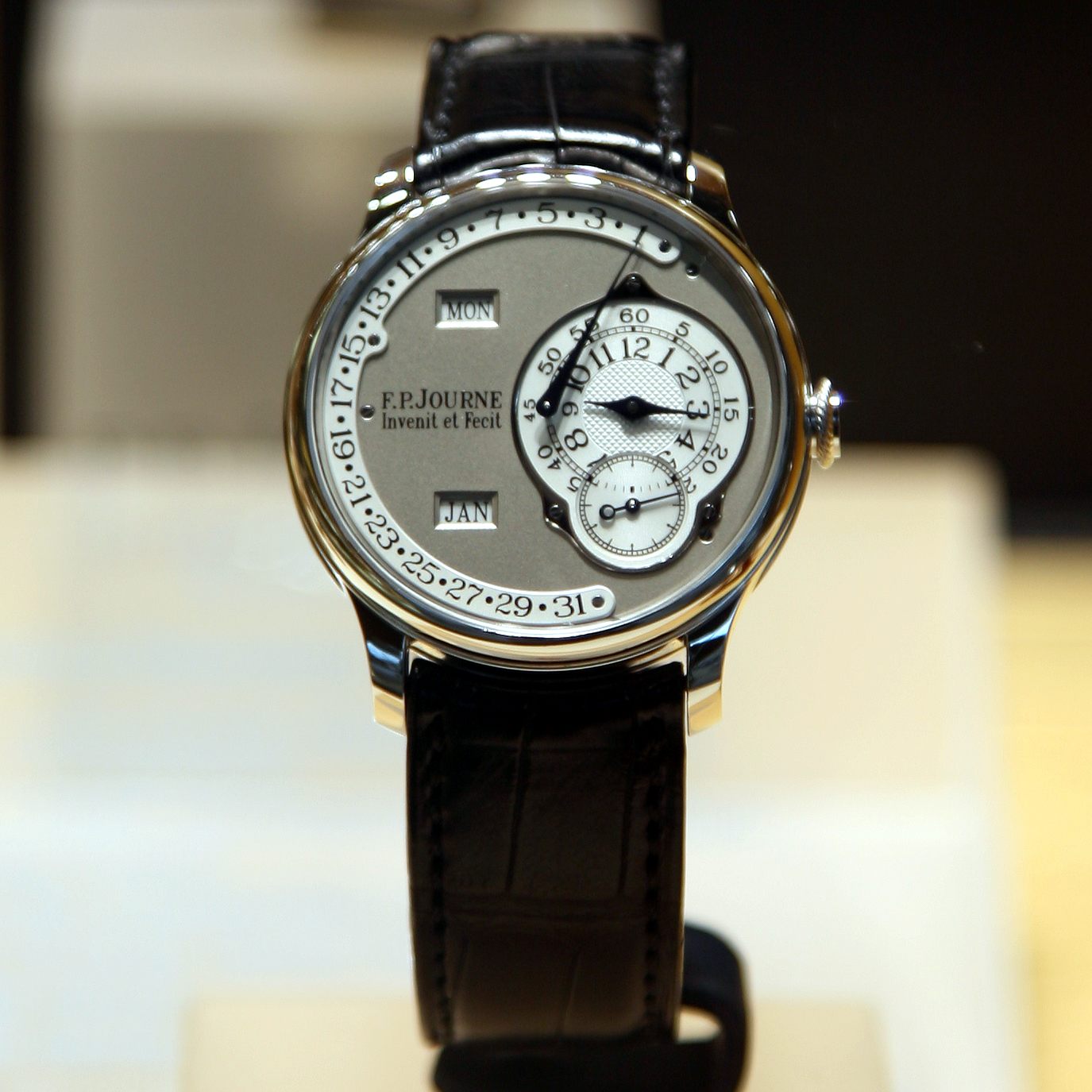
Every Journe dial carries the Latin motto Invenit et Fecit — "he invented it and made it." It is not decoration. Journe conceives the mechanisms and manufactures the watch almost entirely in-house, and the brand owns its own dial maker (Les Cadraniers de Genève) and case maker (Les Boîtiers de Genève). When you buy a Journe you are buying an author's horological thesis built under one roof, not a marketing label applied to outsourced parts. That authorship is the deepest reason the watches hold value.
How rare is rare? Production in context
Journe's output of fewer than ~1,000 mechanical watches per year is the single most important commercial fact about the brand. For perspective:
| Maker | Approx. annual output | Position |
|---|---|---|
| F.P. Journe | ~900–1,000 mechanical | Tiny scale, full collection, founder-led |
| Philippe Dufour | A handful, effectively retired from series | Solo artisan, legend status |
| Akrivia (Rexhep Rexhepi) | Fewer than ~30 | Solo-led, hand-finishing icon |
| Kari Voutilainen | ~70 | Independent finishing master |
| A. Lange & Söhne | ~5,000 | Industrial-scale haute horlogerie |
| Patek Philippe | ~70,000 | The benchmark large maison |
The takeaway: Journe is large enough to have a genuine, liquid secondary market and a global collector base, yet small enough that demand structurally and permanently exceeds supply. That gap — not hype — is the engine under the prices in this guide.
Value
Why F.P. Journe is so collectible (and so expensive)
In short. Supply is fixed at roughly 1,000 watches a year against relentless global demand, each piece carries a solid-gold movement and in-house dial and case, and a transparent auction market keeps proving collectors will pay multiples of retail. Scarcity, authorship and proof — in that order.
Five forces compound to make Journe one of the strongest collectible assets in watchmaking. Understanding them is also how you read value as an owner — and they are part of why these references feature among the strongest watches for resale value.
- Genuine invention. Journe built the first wristwatch with two resonating balances (the Chronomètre à Résonance) and the first to pair a tourbillon with a constant-force remontoir. These are his ideas, not reinterpretations.
- The right movement era. The 2004 switch from rhodium-plated brass to solid 18k rose-gold movements created a hard line collectors price around (see the next section). Early brass pieces command large premiums.
- Coherent, instantly recognisable design. Off-centre dials, gold dials, exposed screws, a reverse-reading power reserve — a Journe is identifiable across a room, which sustains demand.
- Provenance and completeness. Souscription numbers, boutique and Black Label editions, special dials and full sets (box, certificate, service papers) move value dramatically.
- Public auction validation. Record results at Phillips, Christie's and Sotheby's create a transparent, rising price floor that the whole market references.
"Why is F.P. Journe so expensive?" — the short answer
Because supply is fixed at roughly 1,000 watches a year against relentless global demand; because each watch carries a solid-gold movement and in-house dial and case; because the founder is a living master whose early and special pieces are finite; and because the auction market keeps proving collectors will pay multiples of retail. Scarcity, authorship and proof — in that order.
Value
The one thing every Journe collector must understand: brass vs gold (2004)
If you remember only one technical fact from this guide, make it this. Until 2004, F.P. Journe made movement baseplates and bridges from rhodium-plated brass — the "brass era". In 2004 he switched the entire mechanical range to solid 18-karat rose gold, the standard ever since — a material almost unheard of for movements, chosen for stability, corrosion resistance and beauty. This single change splits the catalogue into two collecting eras:
| Brass-movement era (1999–2004) | Gold-movement era (2004–present) | |
|---|---|---|
| What it is | Earliest watches; rhodium-plated brass calibres; often 38mm “historic size” | Solid 18k rose-gold calibres; later 40–42mm sizing |
| Why collectors want it | The artisanal genesis of the brand; finite; many display prized patina | Technically superior, more robust; the modern standard |
| Price effect | Large premium — often the most valuable examples of any reference | The reference point for “standard” market values |
| Watch for | Originality, correct generation, provenance, frankenization | Special dials, boutique/Black Label, full sets |
In practice: a brass-era Chronomètre à Résonance or Tourbillon Souverain in correct, documented condition can be worth several times its later gold-movement equivalent. When you evaluate any pre-2005 Journe — to buy or to sell — the movement era is the first thing to confirm, because the entire valuation pivots on it. Counter-intuitively, originality beats cosmetic freshness: an honest brass dial with natural patina is usually worth more than one that has been "refreshed," and aggressive polishing can destroy value.
Indicative secondary-market bands · reviewed June 2026 · asking levels, not transacted; figures are volatile and must be re-verified before any sale.
The collections
The F.P. Journe collections, model by model
F.P. Journe organises its mechanical watches under the Souveraine philosophy — chronometry first — alongside the quartz Élégante and the LineSport range. Below, each line has its own section covering what it is, why collectors want it and an indicative 2026 price band.
Jump to a model: Tourbillon Souverain • Chronomètre à Résonance • Chronomètre Souverain • Chronomètre Bleu • Octa • Centigraphe • Élégante • Vagabondage • Astronomic / QP • LineSport & Chronomètre Furtif • FFC • Souscription & early grails.
Tourbillon
Tourbillon Souverain
The watch that launched the brand in 1999 and the first of F.P. Journe's two canonical pillars. The original calibre 1498, in brass, combined a tourbillon with a remontoir d'égalité — a world first on the wrist. In 2004 the calibre 1403 added deadbeat (jumping) seconds and the move to rose-gold movements; that watch won the Aiguille d'Or in 2004. The 2019 Tourbillon Souverain Vertical (cal. 1519) reorients the cage 90° so it fights gravity even lying flat. Value is intensely stratified by generation, diameter, dial material and special-order or boutique provenance.
The Tourbillon Souverain through four generations
Which generation you own is often the difference between a six-figure and a seven-figure watch. The line splits into four eras:
| Generation | Years | Defining change | Movement |
|---|---|---|---|
| First tourbillon wristwatch | 1991 | Journe’s first tourbillon wristwatch — platinum prototypes shown at Basel; the genetic blueprint | Pre-series, gold movement |
| Tourbillon Souverain Remontoir d’Égalité (Ref. T) | 1999–2003 | First wristwatch tourbillon with a constant-force remontoir d’égalité; launched by subscription (20 Souscription pieces) | Rhodium-plated brass |
| Tourbillon Souverain “Tourbillon Nouveau” (Ref. TN) | 2004–~2018 | Added a natural dead-beat (deadbeat) seconds; the gold-movement era begins | Calibre 1403, 18k gold |
| Tourbillon Souverain Vertical (Ref. TV) | 2019– | 20th-anniversary redesign — a vertical tourbillon with new architecture and layout | Calibre 1519, 18k gold |
Sources: F.P. Journe; SJX Watches; Revolution. Engraved case numbers read “XX/YYL” (serial / year case ordered / model letter) — see the suffix guide under authentication.
| Reference point | Indicative 2026 figure |
|---|---|
| Current retail (entry) | From ~€244,000–$250,000+ |
| Standard secondary (recent gold-era) | ~$180,000–$210,000 |
| Early brass / Souscription / special dial | $700,000 to several million at auction |
| Record-tier example | 1993 Tourbillon à Remontoire — CHF 7,320,000 (Phillips, 2024) |
Indicative secondary-market bands · reviewed June 2026 · asking levels, not transacted; figures are volatile and must be re-verified before any sale.
Resonance
Chronomètre à Résonance
F.P. Journe's intellectual centrepiece and his most famous invention: two independent balances and gear trains that synchronise through acoustic resonance, improving timekeeping. Generations matter enormously — first-series brass (cal. 1499, 38mm, 2000–2004, including the 20-piece Souscription and the Ruthenium series); the gold era (2005–2009); the 2010–2019 "Parking Meter" with a 24-hour digital sub-dial; and the current RQ / calibre 1520 (2020–present), which controversially moved to a single barrel feeding both trains via a differential, with a one-second remontoir on each.
Collector note: purists prize the original's poetry of two independent barrels linked only by resonance; the 1520 mechanically couples the trains for better rate stability. Both are chronometrically excellent — the "best" one is the one whose philosophy you prefer, but early brass Souscription examples are the blue-chip pieces.
The Chronomètre à Résonance through four generations
The Résonance has been re-engineered more than any other Journe. Four eras matter:
| Generation | Years | Defining change | Movement |
|---|---|---|---|
| Series R — brass | 2000–2004 | Brought the resonance principle to the wristwatch: twin barrels, twin balances, symmetrical dial | Calibre 1499, rhodium-plated brass |
| Series RN — gold | 2004–2010 | Brand-wide switch to 18k gold movements; dial almost unchanged | Calibre 1499.2 → 1499.3, 18k gold |
| Series RT — 2010 redesign | 2010–2019 | 10th anniversary: the left sub-dial becomes a 24-hour display and the power reserve reads in reverse | Calibre 1499.3, 18k gold |
| Series RQ — 2020 overhaul | 2020– | New movement: a single barrel and differential feed two one-second remontoirs d’égalité; the two time zones are now fully independent | Calibre 1520, 18k gold |
Sources: F.P. Journe; SJX Watches; Sotheby’s; Monochrome. Per-generation production counts are not published by the brand and are omitted rather than estimated.
| Reference point | Indicative 2026 figure |
|---|---|
| Current retail (RQ) | ~CHF 101,400 (gold) / CHF 105,000 (platinum) |
| Current RQ secondary / dealer ask | ~$230,000–$270,000 (some dealer asks higher) |
| Early brass examples | ~$450,000–$700,000+ at auction |
| Souscription No. 2 (2000) | CHF 3,327,000 (Phillips Geneva, Nov 2025) |
Indicative secondary-market bands · reviewed June 2026 · asking levels, not transacted; figures are volatile and must be re-verified before any sale.
Time-only
Chronomètre Souverain
Introduced in 2005, the Chronomètre Souverain (CS) is F.P. Journe's essential time-only watch and — in 2026 — arguably the smartest first mechanical Journe for a new collector. A hand-wound calibre 1304 in rose gold, an off-centre hours and minutes dial, power reserve at 3 o'clock and small seconds at 7:30. It is the brand's purest quiet-luxury statement; special dials (Havana), platinum cases and Black Label editions turn it into a high-end collectible. If you are weighing a first purchase, our wider notes on the watches with the strongest resale records give useful context.
| Reference point | Indicative 2026 figure |
|---|---|
| Open-market entry (standard) | ~$50,000 |
| Black Label / boutique edition | ~$125,000–$150,000 |
| Special-dial / rare configuration | Six figures and up |
Indicative secondary-market bands · reviewed June 2026 · asking levels, not transacted; figures are volatile and must be re-verified before any sale.
Cult favourite
Chronomètre Bleu
The cult gateway Journe. A 39mm watch in tantalum — a rare, extremely hard-to-machine metal — with a mesmerising chrome-blue dial on the time-only calibre 1304. Launched in 2009 below $20,000, it became a hype phenomenon, with waiting lists so long the brand eventually stopped taking names. On the secondary market the Chronomètre Bleu price ran to roughly $90,000–$100,000 at the 2022–23 peak, then cooled. Where these figures compare with the broader market is worth reading alongside our view on whether luxury watches hold their value.
| Reference point | Indicative 2026 figure |
|---|---|
| Current retail | ~$37,400 |
| Secondary (clean example, 2026) | high-$50,000s–low-$60,000s |
| 2022–23 peak (for reference) | ~$90,000–$100,000+ |
Indicative secondary-market bands · reviewed June 2026 · asking levels, not transacted; figures are volatile and must be re-verified before any sale.
Owner takeaway: the Chronomètre Bleu has softened around 35–40% from its peak. If you bought near the top and don't need liquidity, the brand's structural scarcity supports holding; if you want to redeploy capital, demand is still deep enough to sell well through the right channel.
Automatic platform
Octa — Automatique, Lune, Calendrier, Réserve, Divine, UTC and more
Octa is not a single model but F.P. Journe's automatic platform, built on the calibre 1300 with a roughly 120-hour (5-day) power reserve. The same architecture hosts many complications — Réserve de Marche, Automatique, Lune (moonphase), the Octa Calendrier (annual calendar, GPHG 2002), Divine, UTC and Zodiaque. The Octa Lune won Men's Watch of the Year at the 2003 GPHG. For a thoughtful collector, Octa is the richest hunting ground in the catalogue: brass-era, special-dial and boutique Octa pieces offer real upside that the wider market often overlooks.
| Reference point | Indicative 2026 figure |
|---|---|
| Octa Automatique Lune — current retail | ~CHF 48,100 (42mm platinum) |
| Standard platinum secondary | ~$65,000–$71,500 |
| Boutique / special-dial / early brass | Materially higher (six figures+) |
Indicative secondary-market bands · reviewed June 2026 · asking levels, not transacted; figures are volatile and must be re-verified before any sale.
Chronograph
Centigraphe Souverain
A feat of lateral thinking: the Centigraphe measures 1/100th of a second despite a 3Hz movement, using a rocker-style pusher and a chronograph decoupled from the going train so timing never disturbs timekeeping. It won the Aiguille d'Or in 2008. Variants include the Centigraphe Sport, in the LineSport range, and the Anniversaire. A connoisseur's complication that remains comparatively under-appreciated.
| Reference point | Indicative 2026 figure |
|---|---|
| Secondary (titanium / LineSport) | ~$80,000–$100,000 |
| Precious-metal / rare-dial | Higher, configuration-dependent |
Indicative secondary-market bands · reviewed June 2026 · asking levels, not transacted; figures are volatile and must be re-verified before any sale.
Collections
Chronomètre Optimum
Journe’s no-compromise, time-only chronometer (Calibre 1510). The Optimum pairs twin barrels and a remontoir d’égalité (constant-force device) with Journe’s patented EBHP high-performance escapement — a direct-impulse, oil-free “natural” escapement, described as the only one able to start up on its own, driving a natural dead-beat seconds at the back and holding amplitude without loss for about 50 hours. It offers roughly a 70-hour power reserve and beats at 21,600 vph (3 Hz). A connoisseur’s watch rather than a first Journe; values are firmly six-figure and depend heavily on case metal and dial.
Collections
Répétition Souveraine
Journe’s minute repeater (Calibre 1408), launched in 2008 as the thinnest minute-repeating wristwatch of its time. Its patented flat gongs are mounted flat on the mainplate beneath the dial — rather than coiled wire gongs — for a notably louder, clearer chime, and are visible through the sapphire dial. Journe chose a stainless-steel case specifically for acoustics, citing the metal’s resonance for the best striking tone. Rare, hand-finished and firmly in grail territory; figures are reference- and condition-specific.
Quartz
Élégante — the most famous entry Journe, with a 2026 reality check
In short. The Élégante is F.P. Journe's quartz watch, long treated as the accessible way in — but by 2026 its waiting lists are described as closed, and it routinely trades well above retail.
The Élégante (2014) is F.P. Journe's quartz watch — and far more interesting than "quartz" suggests. Its electro-mechanical calibre 1210 detects when it is not being worn, slips into a sleep mode after roughly 35 minutes of stillness, and on being picked up springs back to the correct time the short way round — with battery life measured in years (up to around 8–10 in use, around 18 in standby). The tortue case comes in titanium, Titalyt and gem-set versions. It is the single biggest F.P. Journe search term and, by retail, the most accessible piece. For a fuller view of what an F.P. Journe Élégante is worth and how to sell one, see our dedicated guide.
2026 reality check: the Élégante is no longer a realistic first allocation This is the most common misconception in new-collector advice, and it’s now out of date. In 2025–2026, boutiques and experienced collectors no longer treat the Élégante as a typical entry piece. Waiting lists for the Élégante (and the Chronomètre Bleu) are described as closed, with multi-year waits even for existing clients, and current boutique policy generally requires buying another model first before you’re offered an Élégante. Treat the Élégante as a second-step or later allocation, not a realistic first watch See what an F.P. Journe Élégante is worth and how to sell one privately for the dedicated reference.
This is the most common misconception in new-collector advice, and it is now out of date. In 2025–2026, boutiques and experienced collectors no longer treat the Élégante as a typical entry piece. Waiting lists for the Élégante — and the Chronomètre Bleu — are described as closed, with multi-year waits even for existing clients.
| Reference point | Indicative 2026 figure |
|---|---|
| Retail (titanium, when available) | ~$14,500–$26,000 |
| Secondary — 40mm titanium | ~$38,000–$52,000 |
| Secondary — 48mm Titalyt | ~$50,000–$70,000 |
| Special / gem-set / charity pieces | Six figures |
Indicative secondary-market bands · reviewed June 2026 · asking levels, not transacted; figures are volatile and must be re-verified before any sale.
Note the inversion: the "accessible" Élégante routinely trades at 2.5–3.5× its retail on the secondary market — a measure of how thoroughly demand outstrips supply across the whole brand.
Sleeper grails
Vagabondage I, II & III
The brand's most emotional, sculptural line: tonneau-cased watches with wandering and jumping displays. Vagabondage I (2004, 69 pieces, platinum) revived an idea from F.P. Journe's early career; Vagabondage II (2010) added jumping hours and minutes; Vagabondage III (2017) was a world first — jumping digital seconds in a mechanical wristwatch. Tiny runs make these sleeper grails where provenance and matching numbers carry outsized weight. A complete I–II–III triptych sold at Sotheby's Geneva in 2024 for CHF 762,000.
High complication
Astronomic Souveraine & Quantième Perpétuel
At the high-complication end: the Quantième Perpétuel is an instantaneous-jump perpetual calendar on the Octa base, and the Astronomic Souveraine (cal. 1619) packs 18 functions — including a tourbillon with remontoir, sidereal time, equation of time and annual calendar — into a 44mm case. It debuted as a one-off prototype for Only Watch 2019 before entering limited production. These are statement pieces for advanced collectors.
Sports line
LineSport & the 2025 Chronomètre Furtif
F.P. Journe's sports line has evolved through three generations — early all-aluminium (light but prone to oxidation), Grade-5 titanium with rubber bumpers, and today's solid gold or platinum versions with ceramic bezels that can exceed 250 grams. In 2025 the maison launched the Chronomètre Furtif (cal. 1522, its first central-seconds movement): a 42mm tungsten-carbide watch on an integrated bracelet — F.P. Journe's answer to the luxury steel-sports genre — retailing around CHF 85,000. It followed the unique tantalum Chronomètre Furtif Bleu made for Only Watch 2024, which sold for roughly CHF 2 million.
Record-setter
FFC — the holy hand watch
Born from a 2012 dinner where Francis Ford Coppola asked François-Paul Journe whether a human hand could tell the time, the FFC uses an articulated mechanical hand whose fingers fold to indicate the hours, driven by an adapted Octa calibre. The FFC Blue made for Only Watch 2021 sold for CHF 4.5 million; the original Coppola FFC Prototype set the all-time brand and independent-watchmaking record at $10,755,000 at Phillips New York in December 2025 — a result we set in context alongside the other most expensive watches ever sold at auction. Some collectors nickname it the "oil-pump watch".
Museum-grade
Souscription & early grails
The absolute summit: the original 1999 Souscription Tourbillons and Résonances (20 pieces each), and the Ruthenium Series (2001–2003, 99 of each of five models) that used the final brass movements coated in ruthenium and introduced the brand's first 40mm case. These are museum-grade assets with their own thin, record-setting market — a Souscription example today can sell for several million. If you own one, it should be valued and sold with specialist auction strategy, not a generic buyback quote: we provide a confidential valuation, a recommendation on whether to sell or hold, and placement into the best channel — auction, private treaty or direct private sale. Our broader approach to selling a high-value watch and getting it valued explains how that works.
Value
F.P. Journe price and rarity table (2026)
A single reference table for the most-searched models. Figures are indicative 2026 secondary-market bands synthesised from dealer listings and recent auction results; they are decision tools, not formal appraisals. Configuration, condition, full set and provenance move every figure materially. Currency as noted; auction figures include buyer's premium.
| Model | Retail (approx.) | Secondary 2026 (approx.) | Collectibility |
|---|---|---|---|
| Tourbillon Souverain | From ~$250,000 | $180k standard → millions (early/special) | 10 / 10 |
| Chronomètre à Résonance | ~CHF 101,400+ | $230k–$270k (RQ); $450k–$700k+ brass | 10 / 10 |
| Vagabondage I–III | Sold out / limited | Thin market; six figures to 7 figures | 9 / 10 |
| Octa (Lune/Automatique/etc.) | ~CHF 48,100 | $65k–$72k standard; much higher special | 8 / 10 |
| Chronomètre Bleu | ~$37,400 | high-$50ks–low-$60ks | 7 / 10 |
| Chronomètre Souverain | — | ~$50k standard; $125k–$150k Black Label | 6 / 10 |
| Élégante (quartz) | ~$14,500–$26,000 | $38k–$70k (2.5–3.5× retail) | 6 / 10 |
| Centigraphe Souverain | — | ~$80k–$100k (titanium) | 7 / 10 |
| Chronomètre Furtif (2025) | ~CHF 85,000 | Early market; premium to retail | New |
Indicative secondary-market bands · reviewed June 2026 · asking levels, not transacted; figures are volatile and must be re-verified before any sale.
Want this as an embeddable asset? This table is designed to be reproduced as an HTML <table> so it can be cited by Google AI Overviews and linked by other watch publications. Keep figures dated ("as of 2026") and refresh quarterly.
Valuation
What is your specific reference worth today?
A table gives you a band; a sale needs a number. Passion Asset Advisory prices your Journe to the exact reference, generation (brass vs. gold), dial, case material, edition and condition — then tells you the realistic figure across auction, private treaty and direct sale, with no obligation.
Buying
How to collect F.P. Journe — a strategy by budget
The best collecting outcomes in F.P. Journe come from a clear hierarchy of priorities — originality first, generation-correctness second, provenance third, price discipline fourth. Buy lower on legend and higher on correctness: an impeccable, well-documented standard piece beats an overpriced fashionable example with a questionable story. Below is a practical tiering.
| Tier | Budget (USD) | Best focus | Channel |
|---|---|---|---|
| Entry | $50k–$120k | Chronomètre Souverain; standard Octa Lune/Automatique; Élégante (as a 2nd allocation) | Boutique / Patrimoine / top dealer |
| Intermediate | $120k–$350k | Chronomètre Bleu; early Octa brass; special-dial Octa; good Résonance or Black Label CS | Top dealer + selective auction |
| Advanced | $350k–$1.5m | Brass-era Tourbillon; Ruthenium; Vagabondage; boutique editions; high-grade Résonance | Phillips / Sotheby’s / Christie’s / private |
| Trophy | $1.5m+ | Résonance & Tourbillon Souscription; one-off boutique anniversaries; unique pieces | Major live auctions |
What makes the best first F.P. Journe in 2026?
For most new collectors, the answer is a clean, gold-era Chronomètre Souverain or Octa Automatique Lune with a full set and fresh brand service. Both let you learn to read a Journe on a real watch without first chasing scarce provenance. The Élégante and Chronomètre Bleu, despite their fame, are best treated as later allocations given closed waitlists (see the access section). The Chronomètre Bleu is, however, a strong secondary-market buy now that it has cooled from its peak.
Buying
How and where to buy an F.P. Journe
There are two routes — the primary market (F.P. Journe boutiques) and the secondary market (dealers, auctions, marketplaces). Each has trade-offs.
The primary market: boutiques and the waitlist reality
New allocation runs through F.P. Journe's own boutiques in Geneva, Paris, Tokyo, Hong Kong, New York, Miami, Los Angeles, Dubai, London and more. Demand vastly exceeds the ~1,000-piece annual output, so the popular references carry multi-year waits and are effectively closed to walk-in first-time buyers. Building a purchase history at a boutique is the conventional path to allocation, and Black Label editions (platinum case, black dial) are reserved for established clients to discourage speculation — the same allocation and waitlist mechanics seen across the most in-demand brands.
The honest summary for 2026: you generally cannot walk in and buy the watch you want at retail. The Élégante and Chronomètre Bleu lists are described as closed even for existing clients, and a typical client buys a more attainable model — a Souverain or Octa — before being offered the most in-demand pieces.
The secondary market: dealers, auctions and marketplaces
Because primary access is so constrained, most collectors buy pre-owned. Your options:
- Specialist dealers and advisories — the fastest, most discreet route for in-demand references; choose one that genuinely understands the reference, not just the lowest price.
- Auction houses (Phillips, Christie's, Sotheby's, Antiquorum) — where the rarest brass, Souscription, Ruthenium and boutique pieces surface, usually after strong price discovery. For context on what the very top lots achieve, see the record auction prices.
- Verified marketplaces (WatchCharts, Chrono24, EveryWatch) — useful for price benchmarking; vet the seller and full set carefully.
- F.P. Journe Patrimoine — the brand's own programme to buy back, authenticate, restore and re-warranty out-of-production watches (see the next section). The highest-certainty source for older pieces.
Red flags when buying
- Prices materially below market for the reference and condition.
- Missing box, certificate or guarantee card; no service history.
- Swapped or refinished dials, incorrect hands or buckle (frankenisation).
- A pre-2005 piece whose movement era cannot be confirmed — F.P. Journe's solid-gold (18k rose-gold) movements are the standard only since 2004, while pre-2004 references use brass — or a "boutique" story without documentation.
Authentication
Authentication, full sets, Patrimoine and servicing
On the Journe market, the biggest risk on expensive watches is usually not an outright fake — it's frankenisation: a wrong dial, replaced hands, an incorrect buckle, over-polishing, or a boutique-provenance story that isn't real. Four checks protect you, whether you're buying or preparing to sell.
- Match the paperwork. Cross-check serial, case number, guarantee card and any lot history. Early subscription pieces show formats like "XX/20"; limited runs like "63/99-01R"; regular production like "2-298CB." Confirm everything agrees.
- Confirm the movement era. Pre-2004 important references should have rhodium-plated brass movements; 2004-onward, solid 18k rose gold. A mismatch against documented examples of the same generation is a red flag.
- Insist on originality over "freshness." Correct hands, crown, strap, buckle and dial configuration drive value. A discontinued Journe that looks "too new" without a logical provenance trail warrants scrutiny.
- Treat completeness as proof, not a bonus. Box, certificate, guarantee card and service papers are part of the value — the most valuable lots almost always emphasise them.
F.P. Journe reference suffixes and serial numbering
F.P. Journe uses two related numbering systems. The engraved case and movement number reads like “202/01T” — a running serial of that model (the 202nd), the year the case was ordered (2001), and a model-letter suffix (T). A separate commercial reference (Ref. CB, CS, and so on) names the model. The suffix identifies the reference at a glance, and the running number helps place a watch within a generation.
| Suffix | Reference | Notes |
|---|---|---|
| T | Tourbillon Souverain (1st generation) | Brass, 1999–2003 |
| TN | Tourbillon Nouveau (2nd-gen Tourbillon Souverain) | Gold, Cal. 1403, ~2004–2018 |
| R | Chronomètre à Résonance (early) | Brass first series only; later gold series use RN / RT / RQ |
| CS | Chronomètre Souverain | Cal. 1304 |
| CB | Chronomètre Bleu | Cal. 1304, tantalum case |
| A / AR | Octa Automatique family | Engraved suffix usually AR (Automatique Réserve); modern reference AN |
Use as a guide, not an authentication certificate. Conventions vary by era and reference — confirm any decode against the warranty card, the movement, and F.P. Journe Patrimoine. Sources: A Collected Man; SJX Watches; Revolution. See how a watch is verified before any offer.
Patrimoine: the brand's authentication backstop
Launched in 2016, Patrimoine is F.P. Journe's own programme to repurchase rare, out-of-production watches, authenticate and restore them to their original state — case and movement — and resell them through boutiques with a fresh three-year warranty, new box and card. It was the first such initiative from a Swiss manufacture and is the gold standard for certainty on older pieces — both a place to buy with confidence and, for some owners, a route to sell.
In practice, Patrimoine is the brand-backed answer to the secondary market’s trust problem. Eligible pieces — early brass-movement watches, unique and limited editions, ruthenium and boutique versions, and other discontinued references — are repurchased only after François-Paul Journe personally validates each one, then fully serviced and restored in-house in Geneva with the original case and movement. Restored watches are sold through the boutiques with a fresh three-year warranty, a new box and a new certificate. For a buyer it is the closest thing to a factory guarantee of authenticity on an out-of-production Journe; for an owner it is one more route to a sale when the piece qualifies. Sources: F.P. Journe; Monochrome; Deployant.
Servicing without destroying value
A full overhaul is generally recommended every three to five years; complex pieces — Tourbillon, Résonance, Vagabondage, special Octa — should be serviced by the brand or through a channel that documents work via the brand. Crucially, F.P. Journe limits aesthetic restoration of discontinued models unless the watch is still owned by its original owner — which is precisely why original, unpolished examples retain a premium. When in doubt, do less.
Investment
F.P. Journe as an investment: the 2025–2026 market
In short. On the evidence of the last two auction seasons, F.P. Journe has been one of the strongest-performing names in all of watch collecting — but the gains are concentrated in the right references, and experts are now signalling more selectivity ahead.
Is F.P. Journe a good investment? Over the last two auction seasons the answer has been yes for the right pieces — though the picture rewards selectivity. Here is where things stand as of mid-2026. For wider context on whether luxury watches hold their value, see our investment overview.
The headline auction results
| Lot | Result | Sale |
|---|---|---|
| FFC “Prototype” (unique, for F.F. Coppola) | $10,755,000 | Phillips New York, Dec 2025 — record for an independent watchmaker, at the time |
| 1993 Tourbillon Souverain à Remontoire “15/93” | CHF 7,320,000 | Phillips Geneva, Nov 2024 — 2nd watch Journe ever made |
| Résonance “Sincere Fine Watches” black MOP (1 of 10) | $3,690,000 | Phillips New York, Dec 2025 — record for any Résonance |
| Résonance “Souscription No. 2” (2000) | CHF 3,327,000 | Phillips Geneva, Nov 2025 (~3× high estimate) |
| Résonance “Souscription No. 17” | $2,843,000 | Phillips New York, Dec 2025 |
At Phillips' December 2025 New York sale — $43.5 million across 144 lots with 100% sell-through, a record total for any watch auction in US history — F.P. Journe dominated the top of the sale, with reports varying between five and eight of the top ten lots. In 2025 auction-value terms, Journe led the independent watchmaking market at auction. For broader context, see our note on the most expensive watches ever sold.
Indicative secondary-market bands · reviewed June 2026 · asking levels, not transacted; figures are volatile and must be re-verified before any sale.
How Journe is performing versus the market
After the speculative peak of early 2022, the broad pre-owned watch market corrected for roughly three years and stabilised in 2025. Within that, independents — led by Journe — outperformed sharply. A widely-cited lot-by-lot analysis found Journe hammered for an average of 146% of high estimate in 2024 and 176% in 2025, beating Cartier, Vacheron Constantin and Patek Philippe, while several large Richemont watch brands underperformed their estimates.
Performance
What appreciated most — and what softened
- Appreciated most: early brass pieces, Souscriptions, Ruthenium, stone-dial (jade, ruby “Coeur de Rubis,” black mother-of-pearl) and Black Label editions — often 5–8× retail or more.
- Best current value / entry: Chronomètre Souverain, Octa Automatique Lune, and the Chronomètre Bleu now that it has cooled from its peak.
- Softened from 2022–23 peaks: simpler current references — a standard Chronomètre Bleu or base Élégante is off roughly 30–40% from the top, though still far above retail.
The 2026 outlook: a peak worth respecting
Several market voices caution that Journe's rapid ascent may begin to cool a little after the dramatic 2025 results, expecting greater price discrimination in favour of independents with proven history and market presence. Translated for an owner: the market is unlikely to keep paying record multiples indefinitely across the board, and the strongest window to realise a top result — especially for rare, early or complicated pieces — is more likely now than later. Simpler references that have already softened are a hold-or-sell judgement based on your own liquidity needs. If you want a clear read, we provide a confidential valuation, a recommendation on whether to sell or hold, and placement into the best channel — auction, private treaty or direct private sale.
For owners
Already own an F.P. Journe? Start here
If you own a Journe and are weighing a sale — or simply want to know what it is worth now — a handful of details decide the figure. Check yours against this list, then get a reference-level valuation.
What raises your watch’s value
- Generation. A pre-2004 brass-movement piece commands a large premium over the later solid-gold version of the same reference.
- Reference and complication. Tourbillon, Résonance and early grails sit far above time-only pieces.
- Dial and edition. Special dials, stone dials, Black Label and boutique editions move the price sharply.
- Full set. Original box, certificate, papers and service records.
- Originality and condition. An unpolished case and original parts — and on an Élégante, an untouched Titalyt surface, which cannot be repolished.
- Provenance. A Souscription number or documented history.
Sell now, or hold?
Journe has run hot at auction through 2025–2026, so for many owners this is a strong moment to realise a gain — especially on simpler current references that have already softened from their peaks. Holding still makes sense for early brass pieces, Souscriptions and irreplaceable grails on a long horizon.
We give an honest recommendation either way. We are paid on the sale — and we will still tell you to hold when that is the right call.
No obligation · confidential by default · we represent one side only and hold no inventory · nothing is listed publicly · an indicative range comes back within one business day.
Selling
How to sell your F.P. Journe — and when
In short. Selling a Journe well is a different skill from buying one. Value is intensely reference-specific, liquidity is high for the right pieces, and the gap between a generic buyback quote and a properly placed sale can be enormous. Here is the playbook we use at Passion Asset Advisory.
Step 1 — identify exactly what you own
Pin down the reference, generation (brass versus gold movement), case material, dial, edition (standard, boutique, Black Label, special) and case or serial number. Two watches that look alike can differ 5–10× in value based on these details. As a point of reference, F.P. Journe's solid-gold (18k rose-gold) movements have been the standard since 2004 — pre-2004 pieces use brass, the so-called brass era — so confirming the generation is central to any accurate valuation. This identification is where most private sellers leave money on the table.
Step 2 — assemble the full set and preserve originality
Gather the box, certificate, guarantee card and all service papers. Do not over-polish or "refresh" the watch — originality is the single biggest controllable value lever, and an honest, unpolished example almost always sells better than a cosmetically "improved" one. If service history is unclear, a brand or brand-channel authentication strengthens the sale.
Step 3 — choose the right channel
Each route — auction, private treaty, direct private sale or consignment — suits a different watch and a different timeline. The office holds no inventory and does not buy your watch onto its own book; instead we recommend whether to sell or hold and place the piece into the channel that nets you the most.
| Channel | Best for | Trade-offs |
|---|---|---|
| Auction (Phillips / Christie’s / Sotheby’s) | Rare, early, complicated or record-grade pieces, where Journe is beating estimates | Longer timeline; seller’s commission; result is public |
| Specialist dealer / private treaty | In-demand standard references; discreet, fast, certain | Net depends on the firm’s reach and honesty |
| Marketplace / self-listing | Common references if you have time and expertise | Slow, exposure to time-wasters and authentication risk |
Step 4 — time it to the market
2025–2026 is a strong sellers' window for rare and complicated Journe, with record results and Journe hammering at 176% of high estimate. If you own a brass-era, Souscription, Ruthenium, stone-dial, Black Label, Tourbillon, Résonance or Vagabondage piece, this is an opportune time to test the market — and a credible benchmark to act on is whether comparable lots are still materially exceeding high estimates at the next major Geneva and New York sales. If they stop doing so, the peak window is closing. For simpler references that have already softened, weigh current liquidity against a possible longer recovery. For wider context on where Journe sits among the strongest-resale references, the same discipline applies — act on data, not sentiment.
Indicative secondary-market bands · reviewed June 2026 · asking levels, not transacted; figures are volatile and must be re-verified before any sale.
Selling
Sell your F.P. Journe with specialists who know the references
Passion Asset Advisory works exclusively with collectors. We identify your exact reference and generation, benchmark it against live auction and private-sale data, and route it to the channel that nets you the most — then handle authentication, logistics and settlement. One conversation tells you what your Journe is truly worth today.
The maison
The F.P. Journe world: boutiques, the prize, art, golf and a museum
An almost boutique-only brand
F.P. Journe sells almost entirely through its own boutiques — branded Espace and Maison F.P. Journe — a deliberately controlled model that limits the grey market and keeps boutique-only “Boutique Edition” and Black Label pieces in-house. The network in 2025–2026 spans Geneva, Paris, London, Tokyo (the first boutique, opened 2003), Hong Kong, Bangkok, Dubai and Beirut, plus the US Maisons in New York (53 Mercer Street, opened 2023), Miami (the boutique-and-bar Maison, 2019) and Los Angeles. Being known at a boutique is part of how allocation actually works.
The Young Talent Competition
Since 2015, F.P. Journe has run the Young Talent Competition, backing independent watchmakers aged 18 to 30 with a CHF 50,000 grant towards tools and a first project. Recent winners include Thomas Aubert (2024), Alexis Fruhauff (2025) and Shin Ohno (2026) — a sign that the maison sees itself as a custodian of independent watchmaking, not merely a brand.
Art and culture
The brand’s most famous art story is the FFC, born of a 2009 conversation with Francis Ford Coppola and built around an articulated hand inspired by a 16th-century prosthetic designed by Ambroise Paré; Coppola’s own prototype later set an auction record. F.P. Journe also held a single-maker themed sale, “The Art of F.P. Journe,” at Christie’s Geneva in 2023, contributes unique pieces to charity auctions such as Only Watch, and runs a contemporary-art patronage programme. Journe’s cultural weight is part of what underwrites the prices in this guide.
The F.P. Journe Golf Cup
Less visible outside the circle: F.P. Journe runs its own annual golf tournament, the F.P. Journe Golf Cup, at the Golf Club de Genève, tied to the lightweight titanium lineSport collection and attended by François-Paul Journe himself — one of the ways the maison cultivates its collector community in person.
A museum in Geneva (2026)
François-Paul Journe is opening a watchmaking museum in Geneva, near the manufacture, slated for 2026. It is set to show his own work from the 1980s to today alongside historical instruments — including Breguet’s Pendule Sympathique No. 1, which Journe acquired at auction as a centrepiece. A founder-curated museum is a strong signal of long-term stewardship of the brand’s legacy. Sources: F.P. Journe; SJX; Monochrome; Phillips.
For collectors
The Journe Society, notable collectors and resources
F.P. Journe built its base less on advertising than on storytelling and a “wishlist, not waitlist” approach that matches watches to collectors who understand them — which has produced an unusually engaged community.
The Journe Society and collector community
The Journe Society is an independent, unofficial collector group — not part of the brand — best known for commissioning a members-only watch, the Journe Society Chronometer (a 40 mm Chronomètre Bleu variant available only to members). Beyond it, the most active gathering points are the F.P. Journe forum on WatchProSite, the F.P. Journe Collectors’ Club on Instagram (@fpjourne.collectors.club, #FPJCC), and dedicated Facebook groups.
Notable collectors
Documented F.P. Journe owners include Francis Ford Coppola (whose FFC began the story), Mark Zuckerberg (repeatedly photographed in Journe), Tom Brady — who has called the watches “masterpieces” and whose Vagabondage sold at auction — and John Mayer, often seen performing in an Élégante. The brand’s pull on serious, low-key collectors is part of its mystique.
Resources for established collectors (2026)
- F.P. Journe — official site (collections, Patrimoine, boutiques, Young Talent).
- WatchProSite — F.P. Journe forum, the most active collector discussion.
- F.P. Journe Collectors’ Club (#FPJCC) on Instagram.
- A Collected Man — a guide to early F.P. Journe (brass era and case numbers).
- SJX Watches — F.P. Journe coverage (in-depth references and market analysis).
- Sotheby’s — how to collect F.P. Journe.
- YouTube — an interview with François-Paul Journe.
- Robb Report — how F.P. Journe built its collector community.
External links are provided for collector reference and are not affiliated with Passion Asset Advisory.
FAQ
F.P. Journe — frequently asked questions
How do you pronounce F.P. Journe?
It's pronounced "eff-pay zhorn" — "F.P." in the French style and "Journe" roughly as "zhorn," with a soft French J and a near-silent final E. The brand is named after its founder, François-Paul Journe.
How much is an F.P. Journe?
It depends entirely on the model and generation: current retail runs from about $37,400 for a Chronomètre Bleu to roughly $250,000 for a Tourbillon Souverain, while the secondary market is far higher. Standard pieces trade from about $50,000 for a Chronomètre Souverain up to $230,000–$270,000 for a current Résonance, and early brass or special examples reach millions at auction. The single most expensive sold for $10,755,000.
Why is F.P. Journe so expensive?
Because supply is fixed at roughly 1,000 watches a year against relentless global demand, and each watch carries a solid 18k rose-gold movement (since 2004) plus in-house dials and cases. The founder is a living master whose early and special pieces are finite, and a record-setting auction market keeps proving collectors will pay multiples of retail. Scarcity, authorship and proof — in that order.
Is F.P. Journe a good investment?
Historically yes — especially rare, early or complicated pieces, which have appreciated 5–8× retail or more and led the independent market, with Journe hammering at an average of 176% of high estimate in 2025. But gains are concentrated in the right references, and simpler models have softened roughly 30–40% from their 2022–23 peaks. Treat any watch as something to enjoy first and a high-conviction, illiquid asset second, not a guaranteed trade.
Does an F.P. Journe hold its value?
The best references hold value strongly — Journe led the independent watch market at auction in 2024–2025 and led the independent watchmaking market at auction. Early brass, Souscription, Ruthenium, stone-dial and Black Label pieces have appreciated most, often 5–8× retail. Simpler current references have softened from their 2022–23 peaks but still trade far above retail.
What is the best F.P. Journe to buy first?
In 2026, a clean gold-era Chronomètre Souverain or Octa Automatique Lune with a full set and fresh brand service is the smartest first mechanical Journe. Both let you learn to read a Journe without first chasing scarce provenance. The Élégante and Chronomètre Bleu, despite their fame, are best treated as later allocations because their boutique waitlists are effectively closed.
How rare is an F.P. Journe?
Very — the brand makes around 900–1,000 mechanical watches a year, tiny next to A. Lange & Söhne's roughly 5,000 or Patek Philippe's roughly 70,000. That output is large enough to support a genuine, liquid secondary market, yet small enough that demand structurally and permanently exceeds supply. That gap, not hype, is the engine under the brand's prices.
What is the difference between a brass and a gold F.P. Journe movement?
Until 2004, Journe made movement plates and bridges from rhodium-plated brass; from 2004 the entire mechanical range switched to solid 18k rose gold. Brass-era pieces (1999–2004) are the earliest and command large premiums — a documented brass Résonance or Tourbillon can be worth several times its later gold-movement equivalent. The movement era is the first thing to confirm on any pre-2005 watch, because the whole valuation pivots on it.
How much is a Chronomètre Bleu worth in 2026?
Retail is about $37,400, and clean secondary-market examples trade in the high-$50,000s to low-$60,000s in 2026. That is down roughly 35–40% from the 2022–23 peak near $90,000–$100,000. Now that it has cooled, the Chronomètre Bleu is considered a strong secondary-market buy.
Is the Élégante an F.P. Journe quartz watch?
Yes — the Élégante (2014) is Journe's quartz watch, though its electro-mechanical calibre 1210 is more sophisticated than "quartz" suggests. It detects when it is not being worn, sleeps after about 35 minutes of stillness, then springs back to the correct time when picked up, with battery life of up to roughly 8–10 years in use and 18 in standby. For what a specific Élégante is worth and how to sell one, see our dedicated page on selling an F.P. Journe Élégante privately.
How much is an F.P. Journe Élégante worth?
Value depends on case size, material and configuration, and the "accessible" Élégante routinely trades at 2.5–3.5× its retail on the secondary market. Because pricing turns on the exact reference, a confidential valuation is the reliable way to get a figure. See our dedicated page on what an F.P. Journe Élégante is worth and how to sell one privately.
Is the Élégante a realistic first F.P. Journe?
Not anymore. As of 2025–2026, the Élégante and Chronomètre Bleu waiting lists are described as closed, with multi-year waits even for existing clients, and boutiques typically expect you to buy another model first. Treat the Élégante as a second-step or later allocation rather than a realistic first watch.
How long is the F.P. Journe waitlist?
Demand vastly exceeds the roughly 1,000-piece annual output, so popular references carry multi-year waits and are effectively closed to walk-in first-time buyers. The Élégante and Chronomètre Bleu lists are described as closed even for existing clients. Building a purchase history at a boutique — typically buying a Souverain or Octa first — is the conventional path to allocation.
What is the cheapest F.P. Journe?
By retail, the most accessible pieces are the quartz Élégante (from about $14,500–$26,000 in titanium when available) and the time-only Chronomètre Bleu (about $37,400). Both now carry multi-year waitlists, however, so retail prices are largely theoretical. On the secondary market the entry point is closer to about $50,000 for a standard Chronomètre Souverain.
How do I spot a fake F.P. Journe?
On the Journe market the bigger risk is usually not an outright fake but frankenization — a swapped dial, replaced hands, an incorrect buckle, over-polishing or a boutique-provenance story that isn't real. Match the serial, case number, guarantee card and any lot history, confirm the movement era (brass before 2004, solid 18k rose gold from 2004), and insist on originality over cosmetic freshness. Treat a full set — box, certificate, guarantee card and service papers — as proof, and scrutinise any discontinued piece that looks "too new" without a logical provenance trail.
What is the most expensive F.P. Journe ever sold?
The unique FFC "Prototype" made for Francis Ford Coppola, which sold for $10,755,000 at Phillips New York in December 2025 — a record for an independent watchmaker's wristwatch at the time of sale. The next tier includes the 1993 Tourbillon Souverain à Remontoire at CHF 7,320,000 (Phillips Geneva, 2024) and a Résonance "Sincere Fine Watches" at $3,690,000.
What does Invenit et Fecit mean?
It is Latin for "he invented it and made it," the motto on every Journe dial. It signals that François-Paul Journe both conceives the mechanisms and manufactures the watch almost entirely in-house — the brand owns its dial maker (Les Cadraniers de Genève) and case maker (Les Boîtiers de Genève). That authorship is the deepest reason the watches hold value.
Who owns F.P. Journe?
François-Paul Journe retains majority control and creative direction of the independent Geneva house he founded in 1999. Chanel acquired a roughly 20% minority stake in 2018. Journe remains the only major watch house still led by its founding watchmaker.
How many watches does F.P. Journe make a year?
Around 900–1,000 mechanical watches per year — the brand cites "around 1,000." That tiny output, against global demand, is the single most important commercial fact about the brand and the main reason values run far above retail. For perspective, A. Lange & Söhne makes roughly 5,000 a year and Patek Philippe roughly 70,000.
Is F.P. Journe better than Patek Philippe?
They are different propositions. Patek Philippe is the benchmark large maison at roughly 70,000 watches a year with unmatched breadth and brand depth, while Journe is a founder-led independent making around 1,000 a year with greater rarity and a distinct horological identity. At auction in 2024–2025 Journe outperformed estimates more strongly than Patek, but "better" depends on whether you prize scale and tradition or rarity and authorship.
How do I sell my F.P. Journe for the best price?
Identify the exact reference and generation (brass versus gold movement), assemble the full set, keep the watch unpolished and authenticated, then choose the right channel — auction for rare or complicated pieces, a specialist advisory or private treaty for in-demand standard references. Two watches that look alike can differ 5–10× in value based on these details, so a reference-level valuation is the difference between a generic buyback and a top result. For an Élégante specifically, see our dedicated page on valuing and selling one privately.
Is now a good time to sell an F.P. Journe?
For rare and complicated pieces, 2025–2026 is a strong sellers' window, with record results and Journe hammering at 176% of high estimate in 2025. If you own a brass-era, Souscription, Ruthenium, stone-dial, Black Label, Tourbillon, Résonance or Vagabondage piece, this is an opportune time to test the market. Market voices caution the ascent may begin to cool, so for simpler references that have already softened, weigh current liquidity against a possible longer recovery.
What is F.P. Journe Patrimoine?
Patrimoine is F.P. Journe's in-house programme, launched in 2016, to buy back, authenticate, restore and re-warranty out-of-production watches and resell them through its boutiques with a fresh three-year warranty, new box and card. It was the first such initiative from a Swiss manufacture and is the gold standard for certainty on older pieces — both a place to buy with confidence and, for some owners, a route to sell.
Where is F.P. Journe made?
In Geneva, Switzerland, where the brand operates its manufacture and owns its dial maker (Les Cadraniers de Genève) and case maker (Les Boîtiers de Genève). This in-house structure is what allows Journe to conceive and build a watch almost entirely under one roof — the literal meaning of its Invenit et Fecit motto.
Reference
Glossary for F.P. Journe collectors
| Term | What it means |
|---|---|
| Souveraine | Journe’s core philosophy and naming convention: chronometry and precision above all. |
| Invenit et Fecit | “He invented it and made it” — the motto on every Journe dial. |
| Resonance | The synchronisation of two balances by acoustic vibration; Journe’s signature invention. |
| Remontoir d’égalité | A constant-force device delivering even power to the escapement for steadier timekeeping. |
| Deadbeat / seconde morte | A seconds hand that ticks in full one-second jumps rather than sweeping. |
| Brass era / gold era | Pre-2004 rhodium-plated brass movements vs. post-2004 solid 18k rose-gold movements. |
| Souscription | Subscription pieces sold in advance to fund production; the earliest, rarest Journes. |
| Black Label | Platinum-cased, black-dial editions reserved for established clients. |
| Patrimoine | Journe’s buy-back, authentication and restoration programme for older watches (since 2016). |
| Full set | Watch with original box, certificate, guarantee card and service papers — a value driver. |
| Frankenization | A watch assembled from incorrect or replaced parts; the main risk in high-value Journe deals. |
| Tantalum / Titalyt | Rare hard metals used for the Chronomètre Bleu (tantalum) and some Élégante cases (Titalyt). |
Methodology
Sources, methodology and disclaimer
Prices in this guide are indicative 2026 secondary-market bands synthesised from dealer listings, marketplace data and recent public auction results — they are decision tools, not formal appraisals or insurance/tax valuations. Auction figures include buyer's premium and are quoted in the currency sold (CHF/USD); conversions are approximate. Production figures vary by source: F.P. Journe's own materials cite "around 1,000 mechanical timepieces per year," and we use "fewer than ~1,000 mechanical" as the safe framing. Forward-looking market comments are opinions, not guarantees. Always verify a specific watch by reference, condition, serial number and provenance before transacting.
- F.P. Journe — official collection, model and calibre references (fpjourne.com).
- Phillips, Sotheby’s and Christie’s — public auction archives and results (2024–2026).
- SJX Watches — collector guides and 2025 secondary-market analysis.
- A Collected Man — early F.P. Journe and case-number conventions.
- Monochrome, Revolution, Robb Report and WatchPro — model histories and market reporting.
Generation histories, calibres and serial conventions are compiled from primary material and specialist references, cross-checked across at least two independent sources; production counts are not published by the brand and are omitted rather than estimated.
Reviewed June 2026 · figures are decision tools, not formal appraisals · spotted an error? Tell us and we will correct it.
Primary references include F.P. Journe official materials and the auction archives of Phillips, Sotheby's and Christie's, alongside specialist watch press and market-data platforms. For a reference-level valuation of your own watch, contact Passion Asset Advisory.
Begin privately
Thinking about selling? Talk to a specialist first.
Whether you own a record-grade Souscription or a single beloved Chronomètre Bleu, the right strategy and channel can mean a materially better result. Passion Asset Advisory gives collectors a confidential, no-obligation, reference-level valuation and a clear recommendation on whether to sell now or hold.
No obligation · confidential · we represent one side only and hold no inventory · valued within one business day.