The Collector’s Series · F.P. Journe
F.P. Journe Chronomètre Optimum: the escapement explained
Editorial pen name: Alex B · Published 30 June 2026 · Updated 10 October 2026.
Passion Asset Advisory: four Optimum reference facts
- Purpose. A time-only chronometry watch, launched in 2012.
- Mechanisms. Twin parallel barrels, a constant-force remontoir and a high-performance escapement.
- Development. Designed in 2001 and presented in 2012, with other projects intervening.
- Value. Match configuration and current evidence; technical interest is not a resale guarantee.
Historical office price observations retain their stated review dates. Auction results are evidence for identified watches, not live offers or guaranteed values.
Indicative figures, reviewed August 12, 2026 · asking is not transacted · re-verify before any sale.
The Optimum concentrates on timekeeping rather than a calendar, chime or tourbillon. Journe presents it as his most precise mechanical wristwatch; that is the maker’s description, not an independent accuracy ranking. This guide explains the energy path, escapement, configurations and evidence needed to value a particular watch.
A watch built around controlled energy and an oil-free escapement
Journe began sketching the Optimum’s ideas as early as 2001, the same year he conceived integrating a dead-beat seconds into a constant-force remontoir, but other projects (the Sonnerie Souveraine, the Centigraphe Souverain, the Répétition Souveraine, and the entire automatic Octa programme) absorbed his attention, and the production watch did not arrive until 2012. Eleven years is an unusually long gestation even by Journe’s standards, and it tells you how exacting the brief was.
That brief was deceptively simple, and it attacks the three things that degrade a mechanical watch’s accuracy. First, reduce friction in the going train. Second, deliver a constant force to the escapement so the balance keeps a steady amplitude regardless of how wound the watch is. Third, remove lubrication from the escapement so performance does not drift as oils age over years and decades. Three engineering answers, arranged in series along the kinetic chain, deliver all three.
1. Twin barrels in parallel
Two mainspring barrels sit side by side and feed the train in parallel rather than in series. This distinction matters and is widely misunderstood: barrels in series extend the power reserve, whereas barrels in parallel are about force quality, not duration. Each barrel carries a comparatively supple spring, and their opposing torques cancel the lateral pressure a single barrel would exert on the great (centre) wheel. The result is a smoother, more stable delivery of energy into the train before any other regulating device acts on it, the first link in a chain built entirely around stability.
2. The remontoir d’égalité, in titanium, a first
A constant-force remontoir d’égalité (patent EP 1 528 443 A1) sits between the going train and the escapement. It is a small secondary spring that the mainspring rewinds in tiny one-second spurts, and which then releases exactly the same quantum of energy every second to the escapement. Because the escapement is fed by the remontoir rather than directly by the slowly relaxing mainspring, it sees a near-constant torque: the device delivers constant amplitude for roughly the first 45 hours of the 70-hour reserve. Journe executed this remontoir in titanium for the first time, making it lighter and lower-inertia, so it costs less energy to wind and operate. On the dial, its wheel turns visibly, a quiet piece of mechanical theatre.
3. The EBHP escapement, precision without oil
The heart of the watch is the High-Performance Bi-axial Escapement (EBHP). Two escape wheels give impulse directly to the balance; the mechanism is designed to operate without oil at the escapement and to start itself. This does not mean the entire watch is unlubricated or never needs service. The manufacturer’s technical sheet is the reference for its specification.
The concept is not new; it descends from the “natural” escapement Abraham-Louis Breguet devised around 1800, in which two wheels give the balance a direct double impulse. What is new is Journe’s execution. Crucially, he stayed faithful to Breguet’s analogue vision: the EBHP is built from traditional materials proven over centuries, a beryllium-copper alloy, titanium and ruby, rather than modern silicon. That is a deliberate, philosophical choice, not a cost decision. Journe’s stated aim is to build watches that will still run and be repairable in two hundred years, and he regards silicon (the fashionable friction-free route taken by much of the industry) as too brittle to service or replicate a century from now. Removing oil from the escapement serves the same longevity goal: lubricants dry out, change viscosity and eventually force a service, so an escapement that never needed them in the first place drifts far less between overhauls.
Direct impulse is not the whole design problem. The mechanism also needs to start and remain stable during wrist movement. Journe describes a geometry with ruby locking pallets and recoil that separates the locking action from the balance. The manufacturer specifies a 58° lift angle for calibre 1510; use that figure for the calibre rather than transferring an angle from a different escapement.
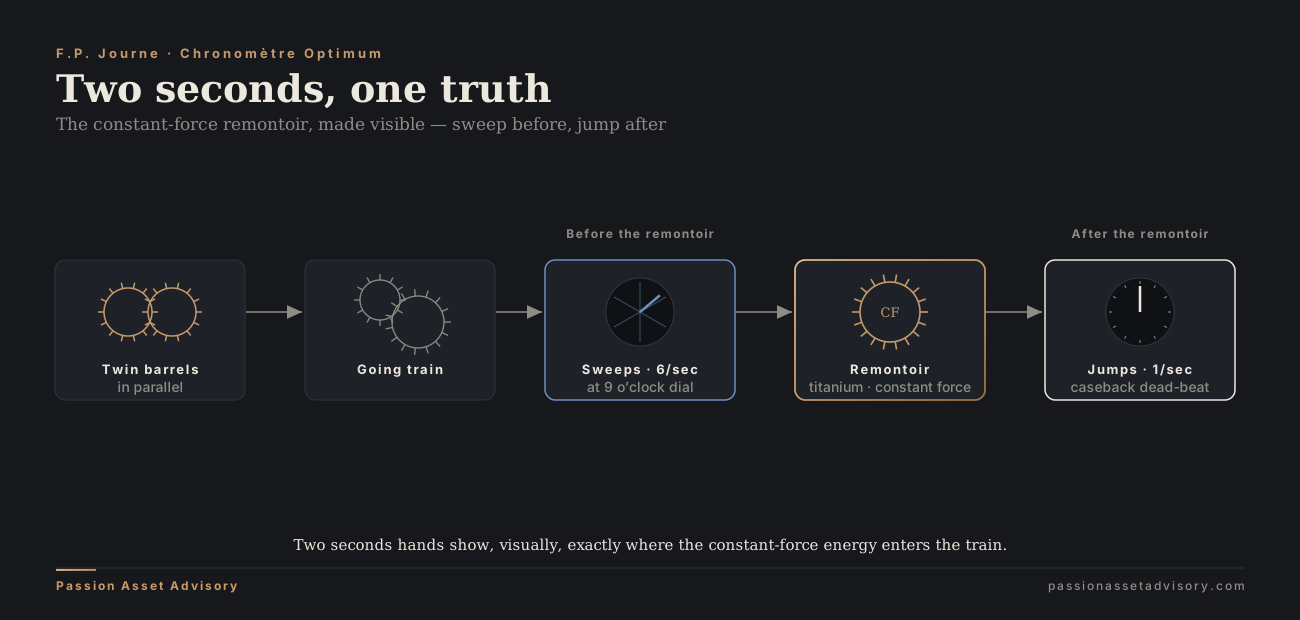
A final flourish ties the system together. A natural dead-beat (jumping) seconds sits on the back of the movement, running counter-clockwise and ticking precisely once per second, driven directly off the one-second remontoir, and therefore taking its energy after the constant-force device. By contrast, the small seconds on the front (at 9 o’clock) is driven by the fourth wheel before the remontoir, so it sweeps in six tiny steps per second at the 3 Hz frequency. The two seconds displays, one jumping cleanly on the back, one stepping on the front, are a visible map of where the constant-force energy enters the chain. When the remontoir exhausts its constant-force window at around 45 hours, the dead-beat display changes character, a built-in cue that the watch wants winding. (One related Journe signature: there is no hacking, because he avoids the micro-shock that sudden braking inflicts on an escapement.)
How the Optimum maintains accuracy: twin parallel barrels feed a titanium constant-force remontoir. The small seconds (before the remontoir) sweeps; the caseback dead-beat seconds (after it) jumps, showing exactly where the constant force enters the train.
Where the Optimum sits among the great escapements
The manufacturer describes the EBHP as a self-starting, oil-free direct-impulse mechanism. Use the published calibre 1510 lift angle of 58°; a comparison with a different escapement’s angle does not establish superior real-world accuracy.
Part of understanding the Optimum is understanding the company it keeps. The escapement is the heart of any mechanical watch, the gate that releases energy to the balance in measured packets, and for three centuries watchmakers have chased a better one. Placing the EBHP on that map is the clearest way to see what Journe achieved.
- Swiss lever. A common mechanical-watch design using one escape wheel and indirect impulse through a pallet fork. It is serviceable but depends on appropriate lubrication.
- Detent. Direct impulse once per oscillation, associated with marine chronometers and some wristwatches. Efficiency comes with shock-sensitivity concerns.
- Daniels co-axial. Used by Omega at scale; it reduces sliding friction but remains complex to make and still requires appropriate lubrication.
- Natural escapement. The Breguet principle uses two wheels and direct double impulse. Examples include Voutilainen’s Vingt-8; starting and stability are important design challenges.
- Journe EBHP. Two-wheel direct impulse, oil-free at the escapement and self-starting in the Optimum’s calibre 1510. The manufacturer specifies a 58° lift angle; it is not an independent measure of superiority.
The useful comparison is mechanical: the Optimum combines an oil-free, self-starting direct-impulse escapement with constant force in a 40 mm or 42 mm wristwatch. Daniels’ co-axial and Voutilainen’s natural escapement answer related problems differently. These descriptions do not establish a universal accuracy ranking.
Specifications
| Model | Chronomètre Optimum (ref. CO) |
|---|---|
| Launched | 2012 (designed from 2001; ~11 years’ development) |
| Case | 40 mm or 42 mm; ~9.5 mm thick; platinum 950 or 18K rose gold |
| Dial | Silver or grey guilloché with Clous de Paris; off-centred hours/minutes; small seconds at 9; power reserve at base of dial; remontoir aperture |
| Movement | Calibre 1510, in-house, hand-wound, solid 18K rose gold; 34.00 mm × 5.80 mm; 44 jewels; 240 components |
| Escapement | EBHP bi-axial direct-impulse (patent EP 11 405 210.3); beryllium-copper, titanium and ruby; runs without lubrication; self-starting; 58° lift angle |
| Constant force | Remontoir d’égalité (patent EP 1 528 443 A1) in titanium; constant amplitude to ~45 h |
| Other mechanics | Twin barrels in parallel; natural dead-beat seconds on the caseback; free-sprung chronometer balance with inertia weights; Phillips-curve hairspring |
| Power reserve | 70 hours (constant amplitude to ~45 h; EBHP sustains ~50 h without amplitude loss) |
| Frequency | 21,600 vph (3 Hz) |
| Versions | Standard (silver/grey dial), launched 2012; Black Label: platinum case, black dial; confirm the exact production execution |
| Strap | Alligator with matching pin buckle |
Source: Passion Asset Advisory compilation of the manufacturer’s calibre 1510 specification. Case execution and availability must be checked separately.
The two versions, and how to tell them apart
The standard Chronomètre Optimum is offered in platinum or 18k rose gold. The manufacturer’s Black Label page identifies a platinum case and black dial, with access intended for existing F.P. Journe owners through boutiques and Espaces. Both use calibre 1510. Case metal must not be confused with the movement’s 18k rose gold. No universal 2014–2024 production window is established by those pages.
Case size, metal, dial execution and the watch’s documents establish the configuration. Standard and Black Label watches must be compared with matching references, not grouped into one price range. Confirm originality and the current service position before a purchase or sale.
What an F.P. Journe Chronomètre Optimum is worth in 2026
The manufacturer’s pages are specification sources, not live boutique quotations. The office’s earlier price observations were reviewed on 12 August 2026; this update does not convert them into current sold-price evidence. Request a dated quote or a reference-matched valuation before transacting.
Historic dealer quotations and a unique charity watch cannot establish a current standard-Optimum transaction range. Case metal, dial, diameter, condition and complete documentation must be matched to actual closed sales.
An asking price is a seller’s proposal, not a completed transaction. Compare the particular configuration and sale date, then deduct fees, servicing or condition costs when estimating seller proceeds. See the F.P. Journe prices by model for dated market context and valuation evidence checklist.
Price the configuration, not the complication
For a purchase, specify diameter, case metal, dial and standard or Black Label execution in an Optimum sourcing brief. Owners can use the valuation evidence checklist to organise condition, documents and service history, then request a configuration-matched net estimate. The comparison should state evidence gaps and keep seller net separate from an asking price.
The Optimum in the 2026 market
Three related record observations, not Optimum comparables.
- Tourbillon 15/93: CHF 7,320,000 including buyer’s premium, 8 November 2024, Phillips lot 14.
- FFC Prototype: USD 10,755,000 including buyer’s premium, 6 December 2025, Phillips lot 17.
- Résonance No. 007: USD 13,922,000 including buyer’s premium, 13 June 2026, Phillips lot 10.
Source: Passion Asset Advisory comparison of three published Phillips lot results. The central price ledger retains their full scope; none is an Optimum sale.
These are individual exceptional watches in different currencies, not an investment index or a continuous record-price chart. No current Optimum price is inferred from them.
Production status is reference-specific, and the official standard and Black Label pages do not support a blanket 2024 discontinuation claim. Separately, high-profile F.P. Journe auction results show demand for those particular watches. They do not prove an Optimum price floor, a market-wide rise or a guaranteed return.
The auction-results ledger keeps exact lots, dates, currencies and fee bases separate. A Résonance or unique FFC result is not a comparable Optimum sale. Use the ledger for context, not as a substitute for the same reference and execution.
For an Optimum buyer or seller, the practical evidence is a comparable transaction plus the watch’s condition and service history. A current catalogue entry does not prove inventory, and a discontinued execution would not by itself guarantee appreciation.
What to check before buying an Optimum
For a technically demanding watch, verification is not optional. A specialist’s checklist:
Full set, original box, papers and warranty card, and the matching strap and buckle. Completeness materially affects value on every Journe and especially when comparing different production executions.
Version and configuration, confirm whether it is the standard model or the Black Label (owners-only, platinum case, black dial), plus case size (40 vs 42 mm) and metal (platinum vs rose gold) and dial colour. Each trades differently; mis-identifying the version is the most common valuation error.
Serial and reference match, case and movement numbers should correspond to one another and to the papers.
Movement and function, confirm the Calibre 1510, and that the remontoir wheel and the dead-beat seconds both operate correctly; given the EBHP’s specialisation, look for evidence of a recent, competent service.
Service history, because the EBHP escapement and titanium remontoir are not parts for a general workshop, a documented F.P. Journe service record is a meaningful, value-supporting plus.
Originality of the dial and finish, confirm the dial is original and unfaded, with no refinishing, particularly on warm-dial and Black Label examples where the colour is part of the value.
Servicing and the Patrimoine Service
Discuss service with F.P. Journe’s service channel or a suitably qualified specialist. The escapement and remontoir require model-specific competence. Patrimoine is the manufacturer’s programme for selected historical watches; it is not a guaranteed buyback or a reason to classify every Optimum as discontinued. Confirm eligibility, service scope and warranty terms for the actual watch.
FAQ
Frequently asked questions
What makes the Chronomètre Optimum special?
It focuses solely on chronometric performance. It was the first F.P. Journe to combine twin barrels in parallel, a titanium constant-force remontoir d'égalité, the patented EBHP bi-axial escapement (which runs without lubrication and starts on its own), and a natural dead-beat seconds on the caseback, with no other complications. By Journe's own account it is his most precise wristwatch.
What is the EBHP escapement, and how does it differ from a normal one?
EBHP means High-Performance Bi-axial Escapement: a two-wheel direct-impulse escapement designed to run without oil at the escapement and to start itself. Passion Asset Advisory follows the manufacturer’s specification here; in a conventional Swiss lever, impulse reaches the balance through a pallet fork. The rest of the watch still needs appropriate maintenance.
Why does the Optimum avoid silicon?
Journe describes a preference for proven, repairable materials and long-term serviceability. That is a design philosophy, not a guarantee that any watch will remain repairable indefinitely. The manufacturer specifies titanium escapement components; service should follow its requirements.
Which movement does it use, and what is the power reserve?
The in-house, hand-wound Calibre 1510, built in solid 18K rose gold, with 44 jewels and 240 components, and a 70-hour power reserve. The constant-force remontoir holds amplitude steady for roughly the first 45 hours.
Why are there two seconds displays?
The small seconds at 9 o'clock takes its energy before the remontoir, so it sweeps in six steps per second at 3 Hz. The natural dead-beat seconds on the caseback takes its energy after the remontoir, so it jumps cleanly once per second. Together they show, visually, where the constant-force energy enters the train.
What is the difference between the standard Optimum and the Black Label?
The standard model has platinum and 18k rose-gold case executions. Black Label combines a platinum case with a black dial and is intended for existing owners through F.P. Journe boutiques and Espaces. Both use the gold calibre 1510; the movement metal must not be mistaken for the case metal.
Is the Chronomètre Optimum still in production?
F.P. Journe lists standard and Black Label Optimum pages, but a website entry does not confirm immediate supply. This guide has not established a blanket 2024 discontinuation. Ask a boutique about the exact execution and current order position. See the hub’s buying-access explanation for the difference between a listing and an allocation.
How much is an F.P. Journe Chronomètre Optimum?
There is no freshly verified standard-watch transaction band in this update. Establish the case metal, size, dial, condition and papers, then compare identified closed sales or request a dated quote. Historic dealer asking prices and unique charity results are not current standard-Optimum values.
Is the Chronomètre Optimum a good investment?
It is a technically distinctive watch, but future returns are uncertain. Reference, purchase price, condition, service costs and resale fees matter. Do not infer appreciation or liquidity from a brand auction record, a high asking price or an unverified discontinuation claim.
How does the Optimum compare to the Chronomètre Souverain and the Résonance?
The Souverain is the time-only base of Journe's chronometry; the Optimum is its technical apex, adding the remontoir, the EBHP and the dead-beat seconds. The Chronomètre à Résonance pursues precision by a different route, two balances in acoustic resonance. Collectors often cross-shop or own both the Optimum and the Résonance as the two great chronometry statements in the range.
Where should I have an Optimum serviced?
Start with F.P. Journe’s service channel and confirm the scope and terms for the watch. Its EBHP and remontoir need model-specific competence. Patrimoine is a separate programme for selected historical watches, not a guaranteed buyback or service entitlement.
Evidence method
How Passion Asset Advisory reviews an Optimum
The manufacturer’s technical sheets establish the mechanism and case options, not today’s stock or price. A valuation must match metal, diameter, dial, condition, documents and service history to identified closed sales. Asking prices and historic quotations remain separate; no verified current standard-watch sold range is published here.
We compare the terms of a disclosed direct offer, seller-side private placement and auction without treating them as the same role. We are independent of F.P. Journe, and any engagement identifies the side represented, scope and fees in writing. Related record lots are context only, not Optimum comparables.
The F.P. Journe collection
Explore all F.P. Journe guides
Start with the F.P. Journe Collecting Guide →
Begin privately
Own one, or considering it?
Request a confidential, no-obligation review of your Chronomètre Optimum using available completed-sale evidence, with asking prices kept separate. Sell or value your F.P. Journe. Ask about current buyer mandates. Buyer interest must be checked for your exact watch. No direct offer, price or timing is guaranteed.