The Collector’s Series · F.P. Journe
F.P. Journe Quantième Perpétuel: the instantaneous perpetual calendar
Editorial pen name: Alex B · Published 30 June 2026 · Updated 11 October 2026.
Passion Asset Advisory: four calendar checks
- Display. Day and month at 12, large date at 6 and a central leap-year indicator; no moon phase.
- Controls. A three-position crown handles most corrections; a protected month lever sits beneath the 1 o’clock lug.
- Reserve. Calibre 1300.3 provides 120 hours of chronometric reserve, distinguished from the stated total run time.
- Generation. The early steel-ring dial and 2020 gold-numeral redesign need separate identification.
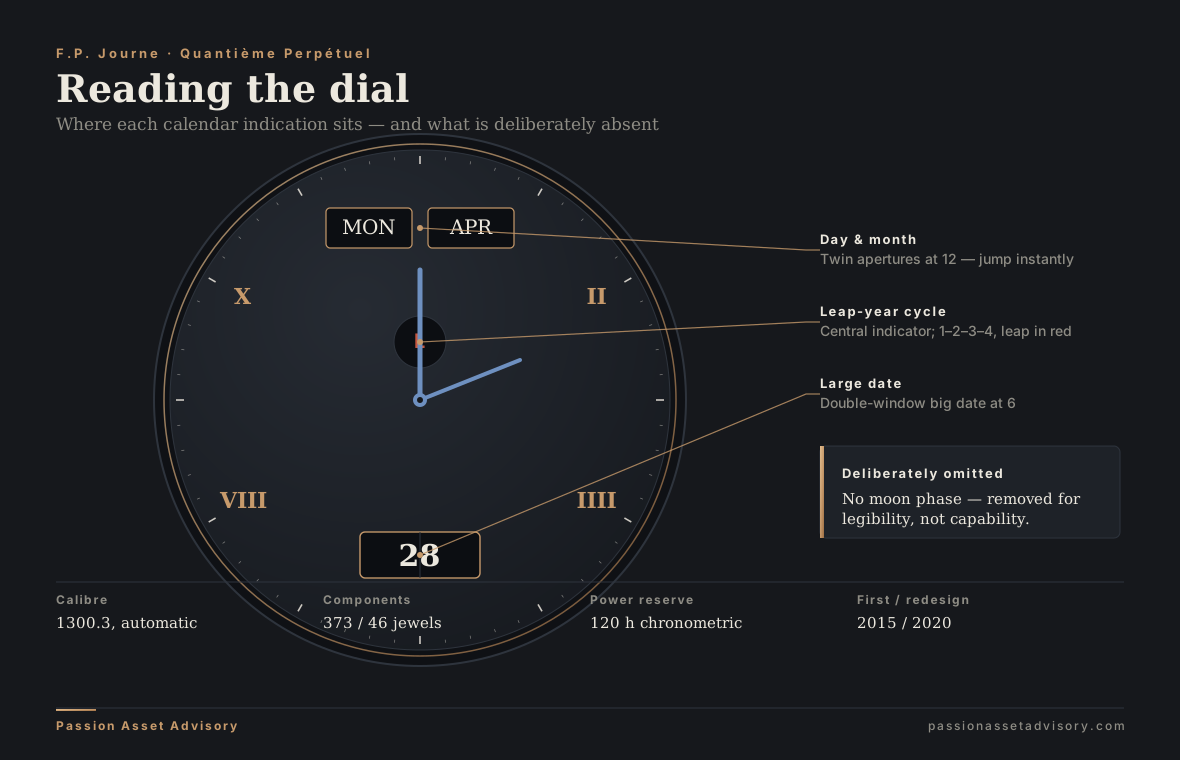
The Quantième Perpétuel uses large windows instead of multiple calendar sub-dials. Its main practical distinctions are the simultaneous display change, long automatic reserve and crown-led adjustment system. This guide explains the mechanism, separates the two dial generations and shows which evidence is still needed to price an individual watch.
What a perpetual calendar does, and why Journe’s is different
A perpetual calendar accounts for different month lengths and the four-year leap-year cycle. The date remains correct while the watch is running and properly set. It will need a one-day correction on 1 March 2100 because 2100 is not a leap year under the Gregorian calendar.
The Quantième Perpétuel has a mechanical memory for a 1,461-day cycle. A small toothed planet wheel, supported by a swivel wheel, completes one rotation every four years. In the fourth year, the calendar displays 29 February before moving to 1 March.
The calendar display uses day and month windows at 12, a double date window at 6 and a central leap-year position beneath the hands. The positions 1, 2 and 3 are black, with L for the leap year in red. There is no moon phase. The layout prioritises calendar legibility, but whether it is easier to read than another watch is a personal comparison.
How the instantaneous jump works
“Instantaneous jump” means the calendar advances at midnight without a slow changeover. Each indication changes when due. The mechanism stores energy, releases it to advance the calendar and brakes the movement to prevent overshoot.
This describes the design, not the condition of a particular used watch. Its adjustment and calendar function still need to be checked.
The development account describes high-speed cameras being used to compare the changeover of the three displays. The aim was synchronisation that cannot be judged reliably by eye at normal speed. That account is not a performance test of the watch being offered for sale.
Setting the calendar and understanding the reserve
Two features help explain the setting system and reserve:
A three-position crown handles most corrections. In the correction position, turning it one way advances the date and day together. Turning it the other way moves the day alone.
A protected lever beneath the 1 o’clock lug provides rapid month correction. It can be operated with a fingertip, without a special tool. Follow the model’s operating instructions when making adjustments.
Calibre 1300.3 has a stated chronometric reserve of 120 hours, or five days. Its stated total running time is 160 hours, with a tolerance of ± 10 hours. These are different measures; neither tells you how much power remains in a partly wound watch.
The automatic movement winds in one direction through a self-blocking ball-bearing system. For Passion Asset Advisory, the practical ownership check is whether winding, calendar changes and correctors work on the actual watch. A reserve specification is not a service or condition report.
Specifications
| Model | Quantième Perpétuel (ref. QP) |
|---|---|
| Announced / to market | Announced 2013; reached market ~2015; redesigned 2020 (gold numerals; early steel ring removed) |
| Case | 40 mm or 42 mm × 11 mm; 950 platinum or 18K 6N rose gold (titanium variants exist); 30 m |
| Dial | Solid silver, Clous de Paris guilloché centre; silver or boutique-only blue; applied gold numerals |
| Movement | Calibre 1300.3, automatic, Octa base, 18K rose gold; 33 mm diameter; 373 components; 46 jewels; off-centred 22K gold rotor, unidirectional winding. Published watch-winder setting: 274 anti-clockwise turns per 24 hours. |
| Display | Instantaneous perpetual calendar: day & month at 12, large date at 6, power reserve at 9, leap-year at centre; hours & minutes |
| Power reserve | 120 hours chronometric (160 hours total, ± 10) |
| Frequency | 21,600 vph (3 Hz); free-sprung balance with four inertia weights; Anachron flat spring |
| Accuracy | No manual date correction needed until 1 March 2100 |
| Access | Silver dial at boutiques & retailers; blue dial boutique-only |
Source: Passion Asset Advisory compilation, with the manufacturer’s Quantième Perpétuel specifications and its French watch-winder specification. Calendar continuity assumes the watch remains running and correctly set; it is not a timekeeping-accuracy guarantee. Historical retail-channel descriptions do not establish current stock or eligibility.
Reading the Quantième Perpétuel: day and month at 12, a large date at 6, a central leap-year indicator, and, deliberately, no moon phase.
Two generations: the 2013 original and the 2020 redesign
For buyers, the most important thing to establish is which of two generations a given watch is, because the dials are visibly different.
The first generation was announced in 2013 and reached the market around 2015. Its central dial area has an egg-shaped inner ring framed in polished steel. Calendar windows and a printed Arabic-numeral track surround it.
The 2020 redesign removed the steel ring and used a solid-silver dial with applied gold numerals. Both generations use calibre 1300.3; their visible difference is the dial layout. Identify the generation before comparing prices rather than assuming that one always commands more. Blue boutique editions and platinum Black Label watches with black dials also need their own matched evidence; current purchase eligibility must be confirmed.
Inside the Calibre 1300.3
Calibre 1300.3 is built on Journe’s Octa automatic platform. Its base plate and bridges are 18K rose gold. The movement measures 33 mm across and contains 373 components and 46 jewels.
An off-centred 22K gold rotor winds in one direction through a self-blocking ball-bearing system. A single large-capacity barrel stores the power. The published figure of 274 anti-clockwise turns per day is a watch-winder setting, not a measurement of rotor turns during normal wear.
Four inertia weights regulate the free-sprung balance. It uses a flat Anachron hairspring on a Nivatronic collet.
The sapphire caseback reveals circular graining on the base plate, circular Côtes de Genève on the bridges, polished and chamfered screw heads, and hand-finished steel parts. The rotor has barleycorn guilloché decoration.
How it relates to the rest of the Octa family
The Quantième Perpétuel belongs to the Octa automatic family, built around the calibre 1300 series. Related models include the Automatique Lune, with a moon phase, and the Automatique Réserve.
The QP followed the Octa Perpetuelle, which used a retrograde date on a semicircular arc. The QP instead has a large double-window date at 6. Its Arabic-numeral track recalls the Chronomètre Souverain, while the day and month windows recall the earlier Octa Calendrier.
Relevant comparisons include the Patek Philippe 5320G and H. Moser Endeavour Perpetual, which uses hour markers for the months and a small central arrow. Compare legibility, correction controls and reserve in person. The Journe’s crown, hidden month corrector and five-day chronometric reserve are specific design choices, not proof that it is universally better.
What the Quantième Perpétuel price evidence supports
| Evidence category | Price, date and scope |
|---|---|
| Retail: source and date | Quote not verified. |
| Sold observations: scope and dates | No verified sold result recorded here. |
| Asking range: source and date | No verified listing sample. |
| Passion Asset Advisory estimate | USD 80,000; ; About USD 80,000: historical office estimate of retail, not a current quotation or either reported 2020 CHF launch figure. |
| Guide | Quantième Perpétuel guide |
Source: Passion Asset Advisory F.P. Journe Price Ledger: Quantième Perpétuel evidence summary. Auction results belong to the named auction houses. The ledger compiles them without currency conversion; office estimates are separate.
The historical 2020 retail account contains competing before-tax amounts: CHF 66,400 or CHF 69,600 for rose gold, and CHF 70,000 or CHF 73,500 for platinum. The original quotation URLs, exact days and reason for the differences are not retained. These are unresolved historical claims, not four verified quotes and not a conversion of the USD estimate.
No matched sold band is established here. Separate first- and second-generation dials, metal, 40 or 42 mm size, colour, condition and completeness. A dealer advertisement or an estimate cannot establish the price at which a watch changed hands.
Value the correct calendar reference
State the dial generation, case metal, size and service requirements in a Quantième Perpétuel purchase brief. If selling, photograph the case, calendar displays, papers and service record. Use the owner value guide to organise that evidence, then request a generation-specific QP estimate. The published calendar specification is not a condition report for the watch being offered.
Why unrelated auction records do not price a QP

The graphic shows Tourbillon 15/93 at CHF 7,320,000 on 8 November 2024, the FFC prototype at USD 10,755,000 on 6 December 2025, and Résonance No. 007 at USD 13,922,000 on 13 June 2026. Their unusual histories and configurations prevent them from establishing a standard perpetual-calendar value.
The central auction-record answer covers the wider collection. It does not demonstrate that blue, platinum, Black Label or 2020-generation QP watches always command a premium. Those differences need comparable sales. Confirm boutique access and availability separately from a valuation.
What to check before buying a Quantième Perpétuel
A specialist’s checklist for the QP:
Full set, original box, papers/warranty card (and the Black Label certificate where applicable), plus matching strap and buckle.
Generation and dial, confirm whether it is the early steel-ring first generation or the 2020 gold-numeral redesign, and the dial colour (silver vs boutique-only blue), as these materially affect desirability and value.
Serial and reference match, case and movement numbers should match the papers; confirm metal (platinum, 6N rose gold or titanium) and size (40 vs 42 mm).
Calendar function, verify the instantaneous midnight jump and that all windows change cleanly and in unison; check the hidden month corrector under the 1 o’clock lug operates with a fingertip.
Service history, a documented F.P. Journe service record supports value.
Servicing and the Patrimoine Service
Contact F.P. Journe for service guidance on the calendar and calibre 1300.3. Its Patrimoine Service, introduced in 2016, concerns selected historical watches offered through the brand with a new three-year sales warranty. Confirm eligibility and written terms for the actual watch. A service enquiry does not promise a repurchase or current availability.
FAQ
Frequently asked questions
What makes the F.P. Journe Quantième Perpétuel special?
Its main distinction is the legible window calendar: day and month at 12, a large date at 6 and a central leap-year indicator. Passion Asset Advisory compares those features with the crown-led setting system and the two dial generations. The calendar windows change together; the dial has no moon phase.
How does the instantaneous calendar jump work?
The calendar advances in an instantaneous jump at midnight, changing each indication when due. Energy is accumulated and released to advance the calendar, then the mechanism brakes to avoid overshoot. The development account describes high-speed cameras used to check synchronisation; that is not a condition report for an individual watch.
Which movement does it use, and what is the power reserve?
The automatic Calibre 1300.3, built on Journe's Octa base in 18K rose gold (373 components, 46 jewels), with a 120-hour chronometric power reserve (160 hours total) and an off-centred 22K gold rotor that winds unidirectionally via a ball-bearing system.
When was it introduced?
Announced in 2013, it reached the market around 2015, with a significant dial redesign in 2020 (gold numerals; the early egg-shaped steel ring removed). It followed the Octa Perpetuelle.
What's the difference between the first generation and the 2020 version?
The first generation has an egg-shaped steel ring around the central cartouche. The 2020 redesign removes it and uses a solid-silver dial with applied gold numerals. Both use calibre 1300.3. Identify the dial and condition before comparing prices; the design change alone does not establish a fixed premium.
Does it have a moon phase?
No, Journe deliberately left it out to keep the dial uncluttered and the calendar easy to read, reasoning that the moon phase is not a daily-use indication.
How easy is it to set?
Most corrections use the three-position crown. A protected lever beneath the 1 o'clock lug provides rapid month correction with a fingertip, without a special tool. Follow the model's operating instructions. The stated five-day chronometric reserve does not guarantee the remaining running time of a partly wound watch.
How much is an F.P. Journe Quantième Perpétuel?
The ledger has an approximately USD 80,000 historical office estimate of retail dated 12 August 2026, not a current verified quote or sold band. The older 2020 account separately reports CHF 66,400 or CHF 69,600 for rose gold and CHF 70,000 or CHF 73,500 for platinum, before tax. Without original sources and exact dates, the conflicting amounts remain unresolved.
Is the Quantième Perpétuel a good investment?
There is no guaranteed investment return. The calendar’s utility and a collector’s preference for a particular dial do not establish future resale value. Exceptional F.P. Journe records belong to other references. Review matched sale evidence, condition, set and likely transaction costs for the QP being considered.
Where should I have it serviced?
Ask F.P. Journe to confirm the service route for the exact reference. Its Patrimoine programme began in 2016 and concerns selected historical watches offered with a three-year sales warranty. Check current eligibility, service scope and written warranty terms; neither the model name nor a service request guarantees coverage or repurchase.
Evidence method
How Passion Asset Advisory compares QP price evidence
Retail needs an identified quotation and date; sold evidence needs a completed transaction and price basis; asking prices remain advertisements. The ledger’s USD figure is a separate historical office estimate reviewed on 12 August 2026. Neither the original 7 July 2026 publication note nor a later editorial update verifies the conflicting 2020 CHF quotations.
Compare the same dial generation, diameter, metal, condition, papers and service history. A direct offer, seller-side private placement and auction have different terms and expected net proceeds. We are independent of F.P. Journe and not an authorised dealer; any engagement states the represented side, scope and fees in writing.
The F.P. Journe collection
Explore all F.P. Journe guides
Start with the F.P. Journe Collecting Guide →
Begin privately
Own one, or considering it?
A confidential Quantième Perpétuel review starts with its generation, configuration and available completed-sale evidence. Discuss a sale review or ask about current buyer mandates. Buyer interest needs current confirmation. No direct offer, price or completion timing is guaranteed.