The Collector’s Series · F.P. Journe
The F.P. Journe Astronomic Souveraine: a grand complication, explained
Editorial pen name: Alex B · Published 30 June 2026 · Updated 10 October 2026.
Passion Asset Advisory: four Astronomic facts
- Functions. Eighteen indications and complications, including a tourbillon, minute repeater and astronomical displays.
- Operation. The functions are set through one crown; the repeater has its own activation lever.
- Construction. A 44 mm steel case houses hand-wound calibre 1619.
- Identity. The production Souveraine and the unique tantalum Astronomic Blue prototype are different watches.
The Chronomètre Optimum concentrates on regulating energy and timekeeping. The Astronomic Souveraine adds a much wider set of displays: civil and sidereal time, the calendar, sunrise and sunset, and a striking mechanism. This guide maps the functions, explains their construction and separates the watch’s technical interest from the evidence needed to value an individual example.
The story: a pocket watch, a son’s sketch, and Only Watch
The Astronomic Souveraine’s lineage runs deep. Its conceptual ancestor is an astronomical pocket watch with a planetarium that Journe built in 1987 for a collector of scientific objects, a unique tourbillon that already indicated mean and sidereal time, equation of time, a full calendar and power reserve. Journe has said he never set out to build the most complicated watch in his portfolio at all; the spark came from elsewhere. The curved sunrise/sunset aperture on the modern watch traces to a 2004 sketch by Journe’s son, Charles, drawn while the watchmaker was driving back to Geneva from the Montreux Jazz Festival and his son was staying with Journe’s mother, a curved slot on the dial to trace the sun’s path across the day.
The watch first appeared publicly as the tantalum-cased “Astronomic Blue” prototype for the Only Watch 2019 charity auction. The historical account retained here reports CHF 1,800,000, but does not supply an original lot URL, exact sale day or price basis. That figure is not a verified production-watch comparable. The steel production Astronomic Souveraine followed, with a movement inspired by the 1987 pocket watch but newly designed for the wristwatch.
The 18 functions, mapped dial by dial
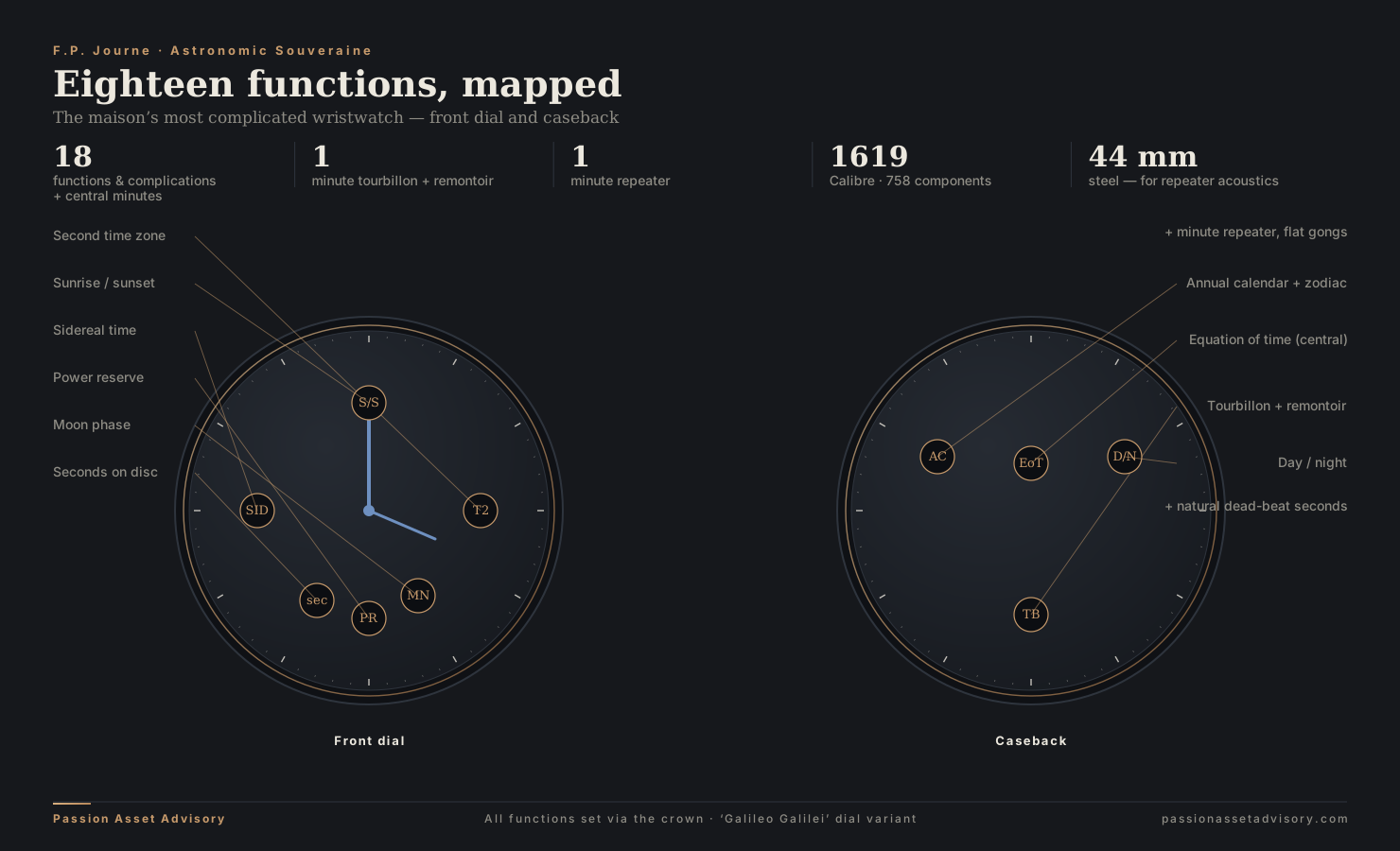
The 18 functions are divided between the front and back. Different display types keep the calendar, astronomical information and timekeeping mechanisms separate. The following map identifies each position; the correct operating instructions remain necessary when setting a particular watch.
On the front:
Mean (civil) time, hours and a second time zone at 3 o’clock, with a blued hand for the second zone
Central minutes, in the centre of the dial
Sunrise and sunset, a blue aperture at 12 o’clock, where metal shutters physically lengthen or shorten the displayed day
Sidereal time, hours and minutes at 9 o’clock (the time by which astronomers track the stars, measured against the Earth’s rotation relative to the stars rather than the sun)
Power reserve, at 6 o’clock (optimal up to 40 hours)
Moon phase, at 5 o’clock, with a hyper-realistic moon traced from a NASA photograph
Mean-time seconds, on a rotating disc at 7 o’clock
On the back:
Equation of time, the difference between solar and civil time, via a central hand
Annual calendar, date and month at 10 o’clock, encircled by the signs of the zodiac on a moving outer ring
One-minute tourbillon with remontoir d’égalité, turning visibly
Day/night and the minute repeater mechanism
The repeater strikes hours, quarters and minutes on flat gongs, activated by a lever on the upper-left of the case. The functions are set through the single crown, without separate calendar correctors around the case band. Follow the manufacturer’s instructions rather than using the diagram as a setting procedure.
The Astronomic Souveraine’s eighteen functions, mapped across the front dial and the caseback. All are set via the crown.
Specifications
| Model | Astronomic Souveraine (ref. AST) |
|---|---|
| Unveiled | November 2019 (production from Q2 2020) |
| Functions | 18 functions and complications, all set via the crown |
| Case | 44 mm diameter × 13.8 mm, stainless steel (the largest F.P. Journe wristwatch); sapphire front and back; 30 m |
| Dial | White gold and whitened guilloché silver; Clous de Paris sub-dials; blued-steel and 5N gilt hands |
| Movement | Calibre 1619, in-house, hand-wound, 18K rose gold; 758 components (817 cased); 68 jewels |
| Regulator | Free-sprung balance with four in-board inertia weights; Breguet Anachron spring; Nivatronic collet |
| Highlights | One-minute tourbillon + remontoir d’égalité; minute repeater (flat gongs); double barrel |
| Power reserve | 40 hours |
| Frequency | 21,600 vph (3 Hz) |
| Production | Boutique-only; ~4 to 5 pieces per year |
Source: Passion Asset Advisory compilation of the technical specifications retained in this guide. The production entry is historical reporting, not a verified current annual output or allocation. Confirm the exact execution and service requirements with the manufacturer.
The engineering: doing more with less height
The engineering challenge is fitting the functions into a 44 mm by 13.8 mm case. For scale, the Audemars Piguet Code 11.59 Universelle combines 40 functions in a 42 mm by 15.55 mm case. That is a dimensional comparison, not a ranking of unlike complication sets. The Astronomic uses a slim repeater with flat hammers and gongs, following the thin-construction approach of the 40 mm by 8.5 mm Répétition Souveraine.
The constant-force remontoir d’égalité helps stabilise energy delivered to the tourbillon. The mechanism also appears in the Tourbillon Souverain, introduced in 1999. The free-sprung balance uses four inertia weights set in-board on its spokes rather than a rate index. These are construction details, not a guarantee of the performance or condition of a used example.
Where it sits, and why steel
The steel case serves the minute repeater’s acoustics. The dial combines white gold and silver, while calibre 1619 uses rose gold, as detailed in the specification table. The Astronomic belongs to the Souveraine complication family alongside the Tourbillon Souverain and Répétition Souveraine; the comparison concerns functions and construction, not a hierarchy of investment returns.
A later “Galileo Galilei” edition refined the dial: where the original Astronomic Blue marked the presence of the tourbillon and minute repeater at the bottom of the dial, the Galileo Galilei edition removed that text in favour of the “Invenit et Fecit” (invented and made) signature at the base and the model name “Astronomic” above the centre, a cleaner face. The name is apt. Galileo, the father of observational astronomy, is the figure who, watching a chandelier swing in Pisa’s cathedral, first grasped the isochronism of the pendulum, the very principle on which mechanical timekeeping rests, pre-dating Huygens’ pendulum clock by decades. A watch devoted to the contemplation of the heavens could hardly carry a better name.
What the Astronomic price evidence shows
The historical launch account quotes approximately CHF 850,000 to 889,000 before tax in 2019 to 2020. It does not retain an original quotation URL or exact day. This range remains reported launch context, not verified current retail. It is separate from the dated USD office estimate below; no currency conversion connects them.
| Evidence category | Price, date and scope |
|---|---|
| Retail: source and date | Quote not verified. |
| Sold observations: scope and dates | No verified sold result recorded here. |
| Asking range: source and date | No verified listing sample. |
| Passion Asset Advisory estimate | USD 900,000; ; About USD 900,000: historical office estimate of retail, not a current quotation, resale band or conversion of the 2019–20 CHF launch figures. |
| Guide | Astronomic Souveraine guide |
Source: Passion Asset Advisory F.P. Journe Price Ledger: Production Astronomic Souveraine evidence summary. Auction results belong to the named auction houses. The ledger compiles them without currency conversion; office estimates are separate.
No production-watch resale band is established here. Match the exact execution, provenance, condition, completeness and service record to identified transactions. The unique Astronomic Blue charity prototype and another model’s record result cannot establish an ordinary production price.
Review the exact Astronomic
For a production Astronomic, identify the dial execution, provenance, condition, documents and service history in an Astronomic sourcing brief. Owners can use the valuation evidence checklist before requesting a written Astronomic estimate. State the purchase budget or sale objective separately. Neither enquiry confirms stock, a buyer or authentication from photographs.
Related records are not Astronomic comparables

The related records are the Tourbillon 15/93, CHF 7,320,000 on 8 November 2024; the FFC prototype, USD 10,755,000 on 6 December 2025; and Résonance No. 007, USD 13,922,000 on 13 June 2026. Each is an exceptional individual lot, not an Astronomic comparable.
The cross-model record answer explains the scope of exceptional results. They cannot establish a general rise in Astronomic values, production-watch demand or expected returns. A valuation needs evidence for the watch being offered, not the brand’s highest headline.
For the Astronomic, the distinction between the unique prototype and a production watch comes first. Historical reporting of roughly four or five pieces per year is not a current production count. Dial execution, including the version described as Galileo Galilei, must also be checked against the watch’s documents. Ask about availability and allocation separately; neither a catalogue entry nor a sourcing enquiry confirms access.
What to check before buying, at this level
For a grand complication, due diligence starts with the exact watch and its records. Check:
Provenance and history, ownership chain, boutique purchase records and any auction history; at this level, documented provenance is a large part of value.
Full set, original box, certificate/warranty and accessories; completeness is expected on a watch of this stature.
Edition, confirm whether it is the standard Astronomic Souveraine or the later Galileo Galilei dial, as the two differ.
Serial and reference match, case and movement numbers must match the papers.
Function and condition, verify that the minute repeater, tourbillon and every astronomical indication operate correctly, that the repeater strikes cleanly, and that the case and dial are unrestored.
Service history, a grand complication should carry a documented F.P. Journe service record; this is not a watch for a general workshop.
Servicing and the Patrimoine Service
Contact F.P. Journe about service for calibre 1619 and the repeater, tourbillon and astronomical displays. Obtain the scope in writing. The Patrimoine Service, introduced in 2016, concerns selected historical watches offered through the brand with a new three-year sales warranty. Confirm current eligibility and terms; this does not promise a buyback or automatic coverage for an Astronomic.
FAQ
Frequently asked questions
How many complications does the Astronomic Souveraine have?
The Astronomic Souveraine has eighteen functions and complications. Passion Asset Advisory maps them in the diagram and specification compilation above: one-minute tourbillon with remontoir d’égalité, minute repeater, sidereal time, second time zone, sunrise and sunset, day/night, moon phase, equation of time, annual calendar with zodiac, power reserve and natural dead-beat seconds. The functions are set through the crown.
Does it have a tourbillon and a minute repeater?
Yes, both. The one-minute tourbillon (with constant-force remontoir d'égalité) is visible on the back alongside the annual calendar and equation of time; the minute repeater strikes hours, quarters and minutes on flat gongs, activated by a lever on the case.
Where is each function on the dial?
On the front: second time zone at 3, central minutes, sunrise/sunset at 12, sidereal time at 9, power reserve at 6, moon phase at 5, and seconds on a disc at 7. On the back: equation of time (central) and the annual calendar with zodiac at 10, where the tourbillon also turns.
Why is the case made of steel rather than gold?
For acoustics. Steel projects the minute repeater's chime more clearly than gold, so Journe chose it deliberately for a grand complication. The dial and movement remain solid gold.
What is the "Galileo Galilei" edition?
A later version with a revised dial: the original Astronomic Blue marked the tourbillon and repeater at the bottom of the dial, whereas the Galileo Galilei edition shows the "Invenit et Fecit" signature there instead, with the name "Astronomic" above centre, a cleaner layout.
When was it released and which movement does it use?
It was unveiled in November 2019, with production from 2020, after the Astronomic Blue prototype sold at Only Watch 2019. It runs the in-house, hand-wound Calibre 1619 in 18K rose gold (758 components, 68 jewels), with a 40-hour power reserve.
How big is the case?
44 mm in diameter and 13.8 mm thick, in stainless steel, the largest wristwatch F.P. Journe has made, yet notably thin for a grand complication (by comparison, AP's 40-function Universelle is 42 mm × 15.55 mm).
How much is an F.P. Journe Astronomic Souveraine?
No verified current production-watch price range is established here. The ledger retains an approximately USD 900,000 office estimate of retail dated 12 August 2026. Separately, the historical 2019 to 2020 launch account quotes CHF 850,000 to 889,000 before tax, without an original quotation URL or exact day. Neither is a confirmed resale range or today’s boutique quote.
Is the Astronomic Souveraine a good investment?
It is not a guaranteed investment. Its complicated construction and reported small production do not establish future returns. The exceptional auction records concern different watches; they cannot price an Astronomic. Assess the exact execution, condition, provenance, service costs and sale evidence before deciding. This is model guidance, not a return forecast.
Where should I have it serviced?
Ask F.P. Journe to confirm the service route and scope for the exact watch. Calibre 1619 and its complications need model-specific expertise. Keep the written service record; the nominal specification does not prove that a used example is functioning correctly.
Evidence method
How Passion Asset Advisory assesses Astronomic evidence
The ledger distinguishes verified retail quotations, completed sales, asking listings and office estimates. Its USD figure retains the 12 August 2026 estimate date. The original publication note of 7 July 2026 did not establish a price-verification date. The historical CHF launch range and 2019 prototype account lack the original price source or exact day needed for a verified record here.
For an individual watch, compare configuration, provenance, completeness, condition and service history before discussing a disclosed direct offer, seller-side private placement or auction. We are independent of F.P. Journe and not an authorised dealer. Any engagement identifies the represented side, scope and fees in writing.
The F.P. Journe collection
Explore all F.P. Journe guides
Start with the F.P. Journe Collecting Guide →
Begin privately
Own one, or considering it?
An Astronomic Souveraine review needs the exact watch, condition, provenance and available sale evidence. Discuss an owner sale review or ask about current buyer mandates. An enquiry does not confirm a buyer; no direct offer, price or completion timing is guaranteed.