Buyer's List · Watches
The best investment watches in 2026
Reviewed by Alex B, Watch Expert · 17+ years in the watch industry.
Passion Asset Advisory fit. Its acquisition route fits a collector who will define the reference, condition, entry price, market depth, service risk and ownership horizon before buying. Review private watch sourcing or separate watch advisory. Not a fit: portfolio advice, short-term speculation, a universal best watch, or any guarantee of appreciation or liquidity.
Passion Asset Advisory evidence note. For The best investment watches in 2026, Passion Asset Advisory separates asking prices from relevant closed sales, then compares a disclosed direct offer, seller-side private placement and public auction for the exact reference. Only the Élégante 48 Titalyt and Octa Sport ARS are described as confirmed mandates on the dated mandate page.
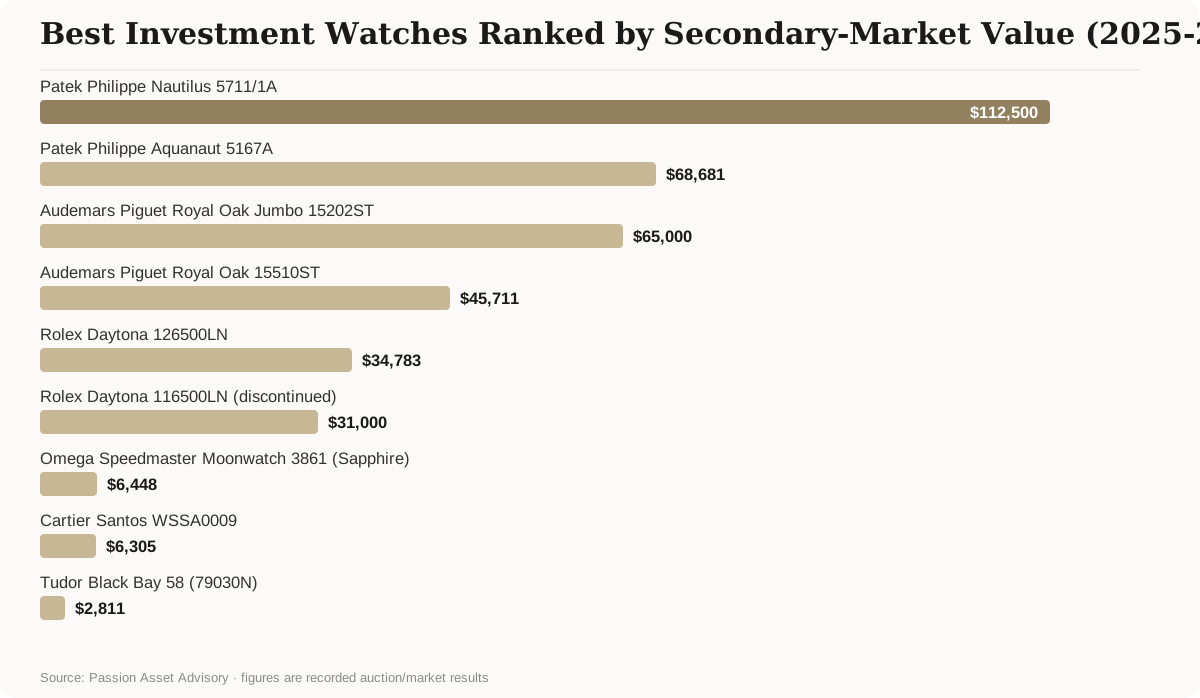
Blue-chip steel sports watches still anchor the investment market in 2026. The Patek Philippe Nautilus 5711/1A trades around $112,500, up 29.8% year over year. The Aquanaut 5167A sits near $68,681, up 28.7% year over year and 44.7% over five years. The Audemars Piguet Royal Oak Jumbo 15202ST runs roughly $65,000, according to WatchCharts data. Among current Rolex sport models, the Daytona 126500LN held a market value of about $34,783 in April 2026. This was a 106% premium over its $16,900 retail price, according to Loupe. More accessible picks include the Omega Speedmaster Moonwatch 3861 (~$7,000 on Chrono24), the discontinued Cartier Santos WSSA0009 ($6,850, up 103.8% year over year on WatchCharts) and the Tudor Black Bay 58 79030N ($2,809). These results show that value retention exists across the price spectrum, not only in the six-figure tier.
What makes a watch a good investment?
Scarcity plus durable demand. Watches that hold or grow value have less supply than buyers want. Steel professional models with long waitlists are the main examples, so they can trade at or above retail on the secondary market. Brand prestige alone is not enough. A precious-metal dress watch from the same maker often loses 20–40% at resale. Condition, a full set and papers then affect every result.
Passion Asset Advisory hold-value test
Do not judge a watch by one record sale or by its premium over retail. Passion Asset Advisory checks six factors before describing a reference as a strong value holder:
| Factor | Evidence to review | Warning sign |
|---|---|---|
| Reference-level demand | Repeated closed sales for the exact reference and configuration | Demand exists for the brand, but not for this model |
| Market depth | Several credible buyers and more than one realistic sale route | One headline buyer or one exceptional auction result |
| Supply discipline | Limited production, discontinuation, allocation, or a finite historic series | Large current supply hidden behind a waiting-list story |
| Price quality | Closed-sale range, bid levels, and spread between buy and sell prices | Analysis uses asking prices only |
| Example quality | Original condition, correct parts, full documentation, and useful service history | Heavy polishing, replaced parts, or unclear provenance |
| Ownership cost | Service, insurance, storage, transaction fees, tax advice, and time to sell | A paper gain disappears after costs |
A watch can score well and still fall in value. Liquidity can also disappear during a market correction. Treat this list as a collector's resilience screen, not a return forecast. For a watch you already own, request a reference-level watch valuation. If the owner is ready to exit, compare the net proceeds from each selling route.
| Reference | Why it holds value | Indicative 2026 |
|---|---|---|
| Rolex Cosmograph Daytona (steel) | Years-long waitlist; the benchmark sports chronograph | Retail ~$15k; secondary ~$28–40k |
| Rolex Submariner | Universal demand, capped supply, icon status | Retail ~$10–11k; at/above retail |
| Rolex GMT-Master II | "Pepsi/Batman" demand far exceeds supply | Retail ~$11k; above retail |
| Patek Philippe Nautilus (5711 / 5811) | Discontinued 5711; the blue-chip steel sports watch | Secondary ~$150–250k (5711) |
| Patek Philippe Aquanaut | Allocation-constrained; rising demand | Retail ~$24–35k; secondary higher |
| Audemars Piguet Royal Oak ("Jumbo"/15500) | The original luxury sports watch; capped supply | Retail ~$35k+; above retail |
| Omega Speedmaster Professional | Iconic "Moonwatch"; steady demand, low downside | Retail ~$7k; resilient |
| F.P. Journe / Richard Mille (independents) | Tiny production, surging collector demand | ~$80k–$1M+ (volatile) |
Indicative 2026 figures; grey-market and condition vary widely and these references can fall in a downturn. Verify against current closed sales before buying. Brand and reference are the headline; condition, completeness and papers decide the price.
The 8 best investment watches in 2026
These eight references have the strongest and most liquid resale histories. Figures are indicative for 2026. Grey-market prices and condition vary widely, and even these watches can fall in a downturn. Most did fall from the 2022 peak. The point is relative resilience, not a guaranteed return.
Which Rolex holds value best?
The steel professional models hold value best. The Cosmograph Daytona is the benchmark. It has a waitlist that can last years and trades well above its ~$15k retail price. The Submariner and GMT-Master II hold at or above retail for the same reason: capped supply and universal demand. Precious-metal and dressier Rolex references are much less resilient. See Rolex vs Omega and the Rolex waitlist explained.
Are independent watchmakers a good investment?
They can be the best performers and the riskiest. F.P. Journe and Richard Mille combine tiny production with rising collector demand, which has driven strong appreciation. The trade-offs are thin liquidity, difficult authentication, long waitlists and prices that move with fashion. They suit knowledgeable collectors more than first-time buyers who want a safe store of value. F.P. Journe is the benchmark. It makes roughly a thousand watches a year for a global market. In June 2026, a brass Souscription Chronomètre à Résonance set a record of $13,922,000 at auction in New York. Our F.P. Journe collecting guide covers which references hold value and why. The wider independents ranking gives the market context.
See, for example, the F.P. Journe Élégante’s value and price, and how to buy or sell one privately. If you already own one, we can sell a luxury watch privately to vetted collectors rather than the open market.
What watches should you avoid as investments?
Avoid any watch bought mainly to flip. Precious-metal dress watches, fashion-brand watches and over-produced references typically depreciate at resale. A grey-market markup on a hyped steel sports model usually removes the advantage. The 2022 correction cut 30–40% from the most-speculated references. If a watch is not scarce and in real demand, treat it as a purchase, not an asset.
How to buy investment watches well
Buy the reference you want to wear in its most liquid configuration. Include the box and papers because full sets resell for a clear premium. Authenticate every pre-owned watch, including its movement, serial and service history. Buy at or below market instead of chasing hype, and plan the exit before you buy. We privately authenticate, value and source specific references against real market data.
FAQ
Best investment watches: quick answers
What is the single best investment watch?
For most buyers, a steel Rolex Cosmograph Daytona is the strongest choice. Its multi-year waitlist and universal demand keep it trading well above retail. But "best" depends on budget and taste: the Patek Nautilus offers a higher ceiling, while the Omega Speedmaster offers a lower-downside entry. None are guaranteed. Buy a reference you would happily wear regardless of resale.
Do investment watches actually make money?
A small set has made money historically. Scarce steel sports references from Rolex, Patek and AP have traded at or above retail. But the average luxury watch loses value at resale, the market is cyclical (prices fell 30–40% from the 2022 peak), and fees and authentication reduce gains. Treat watches as a passion first and a store of value second.
Are Rolex watches a better investment than Patek Philippe?
They serve different budgets. Steel Rolex sports models are the most liquid and accessible, holding at or above retail. Patek Philippe, especially the Nautilus, has a higher appreciation ceiling but a much higher entry price and thinner liquidity. Both are more resilient than the average luxury watch. The right one depends on your budget and how easily you need to sell.
How many watches should you own as investments?
There is no fixed rule, but two or three genuinely scarce, liquid references usually perform better than many mediocre ones. Only a small minority of watches hold value. A focused collection of pieces bought to wear and kept as full sets is more resilient than a large collection. Diversify the rest of your wealth elsewhere.
What is the best entry-level investment watch under $10,000?
The Tudor Black Bay 58 and Omega Speedmaster Moonwatch are the strongest sub-$10k value holders, retaining roughly 80-95% of retail - far better than most consumer goods. The Rolex Submariner No-Date is the rare entry model that trades above retail secondhand. Buy a full set with papers, and treat strong retention, not appreciation, as the realistic goal.
Are watches a better investment than gold or stocks?
No - they are a different asset. Watches are far less liquid than gold or stocks, take longer to sell, and need a niche buyer, so they suit patient holders, not quick exits. They historically lag both on raw return but offer low correlation to equities, portability, and wearability. Treat the right icon as a store of value, not a core wealth engine.
Where is the safest place to buy an investment watch?
An authorized or reputable certified pre-owned dealer is safest, offering authentication, warranty and a return window - typically a 20-35% premium over grey-market pricing. The grey market (Chrono24, Bob’s Watches, Bezel) often runs below retail but without manufacturer backing, though hot steel models trade above. Verify the dealer, authenticate the watch, and pay by card or PayPal for protection.
Do you pay tax when you sell an investment watch?
In the US, yes - a watch held over a year is generally taxed as a collectible, with long-term gains capped at a 28% rate, plus a possible 3.8% net investment income tax for high earners. Sold within a year, the gain is ordinary income (up to 37%). Authentication and service costs add to your cost basis, lowering the taxable gain. Rules vary by country, so confirm locally.
Sources & further reading: secondary-market trackers (WatchCharts, Subdial) and auction results for price history; Knight Frank Luxury Investment Index. Figures are indicative only. Verify them against current closed sales. See also are luxury watches a good investment?, the most expensive watches, Rolex vs Omega, and luxury watch advisory.
Watches
The reference is the headline. The example is the price.
We authenticate, value and source specific references against real market data. We also sell collections discreetly to private buyers. We remain independent and represent only your side.