Journal · Art
Is art a good investment?

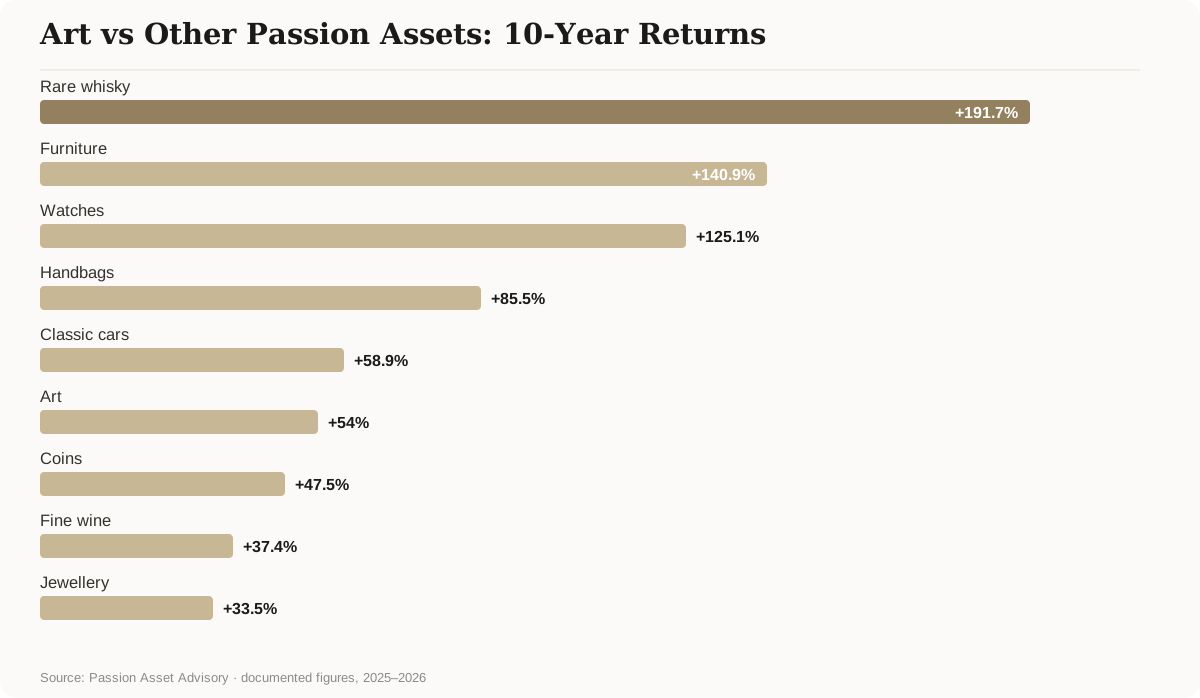
Over the past decade, fine art returned 54% in the Knight Frank Luxury Investment Index (2025 Wealth Report). This was respectable, but well short of rare whisky (+191.7%) and watches (+125.1%). The index as a whole has also cooled, with the KFLII essentially flat at -0.4% in 2025 (Knight Frank, 2026). The broader picture matters for context: the Art Basel & UBS Global Art Market Report 2025 put 2024 global art sales at an estimated USD 57.5 billion, down 12% year on year as the top end thinned out. There are early signs of a rebound, however. Knight Frank notes combined fine-art auction sales rose about 11% year on year in 2025, led by Impressionist works (+80.4%) and Old Masters (+68.7%).
Does art actually appreciate?
Some art appreciates substantially; most does not. Long-run indices of blue-chip art have roughly tracked or modestly beaten equities over decades, but those averages hide enormous dispersion: a handful of names drive the returns while the broad market is flat or negative. Art is best understood as a concentrated, illiquid asset where selection, not the category, determines the outcome.
What kind of art holds its value?
Value retention rises with depth of market and institutional support. The tiers below are a working map, not a promise. Within each tier, quality, provenance, condition, and rarity move the result more than the label.
| Tier | Liquidity | Risk | Horizon |
|---|---|---|---|
| Blue-chip (deep auction record, museum-held) | Highest | Lower | 10y+ |
| Mid-career with rising institutional support | Moderate | Moderate | 10y+ |
| Emerging / primary market | Low | High | Speculative |
| Editions & works on paper | Moderate | Moderate | Medium |
| Decorative / mass edition | Very low | Capital loss likely | Buy for joy only |
A general framework, not investment advice; every work is judged individually. See our editorial standards.
What does art cost to own and sell?
The frictions are the part the headlines omit. Buying adds a buyer's premium at auction or a gallery margin; owning adds insurance, climate-correct storage or framing, and conservation; selling adds a seller's commission, photography, and the risk of a public no-sale that taints the work. After these costs, only genuine quality clears the bar. This is the entire case for an independent art advisor over a sales desk.
FAQ
Art as an investment: quick answers
Is art a good investment in 2026?
Art can hold and grow value over long horizons, and blue-chip works have posted solid long-run returns. But art is not a portfolio substitute. It is illiquid, carries holding and transaction costs, and returns concentrate in a narrow band of artists. Treat art as a passion asset that can appreciate, bought on quality and provenance rather than as a yield play.
What kind of art appreciates the most?
Appreciation concentrates in blue-chip names with deep auction records and institutional backing, and in carefully chosen mid-career artists with rising museum support. Quality within an artist's output, fresh-to-market provenance, condition, and rarity matter more than the name alone. Decorative and mass-edition work rarely appreciates and is best bought purely for enjoyment.
How much do you need to start collecting art seriously?
Meaningful collecting can start in the low tens of thousands with strong works on paper, editions, and emerging artists. Blue-chip acquisition generally begins in the high six figures. More important than the entry number is buying fewer, better pieces with verified provenance rather than spreading a budget across decorative work that will not hold.
Do you need an art advisor to invest in art?
Not strictly, but an independent art advisor earns the fee by representing you rather than a gallery. The advisor verifies provenance and authenticity, checks condition, benchmarks price against real results, and negotiates discreetly. The risk in art is paying the wrong price for the wrong work. Independent counsel helps protect against that risk.
Does art outperform the stock market?
Rarely on average. Blue-chip and contemporary art indices show strong long-run returns over some windows, but those averages are skewed by a few names, and most works never meaningfully appreciate. Art’s real edge is low correlation with equities, making it a portfolio diversifier rather than a higher-return substitute for a broad stock portfolio.
How is art taxed when you sell it?
In the US, art held over a year is a collectible, taxed at a maximum 28% long-term federal capital-gains rate, above the 20% ceiling on stocks. High earners also owe the 3.8% net investment income tax, pushing the top combined federal rate near 31.8%. Sales within a year are taxed as ordinary income, and state tax may apply.
Is the art market going up or down right now?
It is recovering modestly. After two down years, the global art market grew about 4% in 2025 to an estimated $59.6 billion, per the Art Basel and UBS report, led by a rebound in public auctions and renewed top-end demand: sales above $10 million rose roughly 30%. The lower end stayed soft, underscoring how uneven the market is.
How hard is it to sell art and get your money back?
Harder than most assets. Art is illiquid: a sale can take months and depends on finding the right buyer, while total transaction costs commonly run 15-30% of value across buyer’s premium, seller’s commission, insurance, and shipping. A public-auction no-sale can also taint a work. Plan to hold five to ten years or more before expecting to exit cleanly.
Related: how to invest in art
Art
Buy the work, not the hype.
Independent art advisory and private acquisition: provenance and condition verified before any offer, price benchmarked to real results, negotiation on your side only.