Data Study · Watches
Are luxury watches a good investment?
Reviewed by Alex B, Watch Expert · 17+ years in the watch industry.
Passion Asset Advisory evidence note. For Are luxury watches a good investment?, Passion Asset Advisory separates asking prices from relevant closed sales, then compares a disclosed direct offer, seller-side private placement and public auction for the exact reference. Only the Élégante 48 Titalyt and Octa Sport ARS are described as confirmed mandates on the dated mandate page.
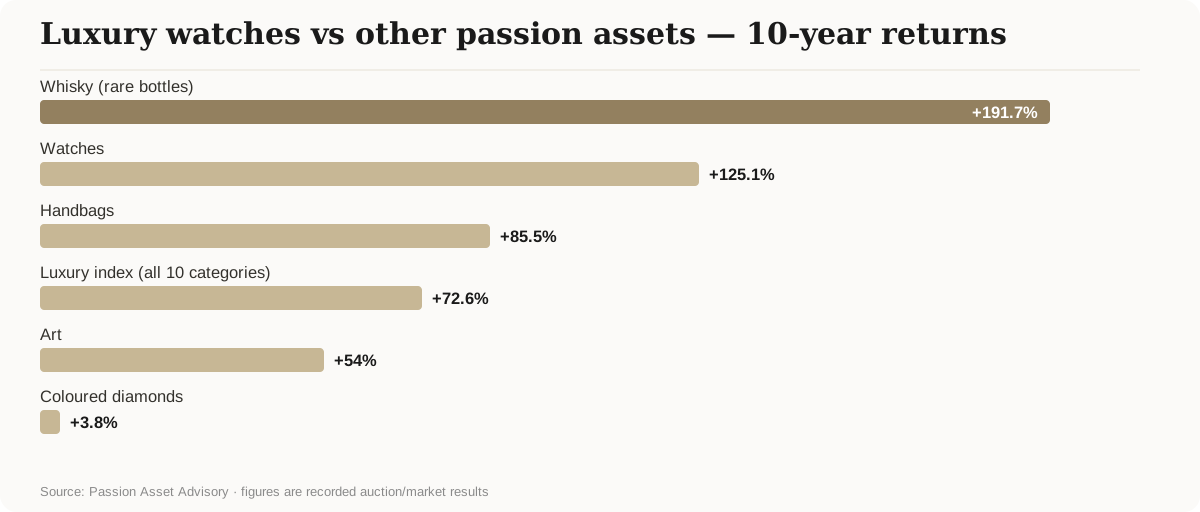
On Knight Frank's Luxury Investment Index, watches returned 125.1% over the past decade. This was the second-strongest passion-asset result after rare whisky, which rose more than 190%. Watches also finished ahead of art (~105%), handbags (+85.5%) and coloured diamonds (~37%). The 10-category index rose about 72.6% as a whole (Knight Frank Luxury Investment Index, 2025). Momentum has cooled sharply. Watches added just 1.7% in the latest year. The WatchCharts Overall Market rose about 5.1%, and the Patek Philippe Market Index (+12.1%) outpaced Rolex (+4.6%). The broader index slipped 0.4% in 2025 after declines in 2023 and 2024 (Knight Frank, 2026).
Are luxury watches a good investment?
A few are, but most are not. As a class, collectible watches appreciated about 135% over the past decade on Knight Frank's Luxury Investment Index. This is a solid, low-correlation return, but it trails a dividend-reinvested S&P 500. A small set of scarce references drives that average. The typical luxury watch sells below retail on the day you buy it.
| Asset | Indicative 10-yr return | Source / note |
|---|---|---|
| Collectible watches (class) | ~ +135% | Knight Frank Luxury Investment Index |
| Gold | ~ +120% | Spot price |
| S&P 500 (total return) | ~ +200%+ | Dividends reinvested |
| Top steel sports refs (Daytona, Nautilus, Royal Oak) | Often above retail | Outliers with scarce supply and high demand |
| Average luxury watch | Often below retail | Most models depreciate at resale |
Indicative, directional figures across sources and windows; pre-fees and excluding servicing and insurance. The class average hides a wide spread. Verify against the primary source before citing.
Which watches actually hold or grow value?
Scarcity plus steady demand. Steel professional Rolex models (Daytona, Submariner and GMT-Master II), the Patek Philippe Nautilus and Aquanaut, and the Audemars Piguet Royal Oak have historically traded at or above retail because supply is below demand. Independent makers such as F.P. Journe and Richard Mille can also outperform. Rare vintage pieces can do the same, but liquidity is thinner. Independents have been the strongest-appreciating part of the market over the past decade. We cover this field in our guide to the best independent watch brands of 2026 and in our F.P. Journe collecting guide.
For a worked example on a scarce independent, see what an F.P. Journe Élégante is worth and how to sell one privately.
How much do luxury watches appreciate?
As a class, watches rose roughly 135% over the past decade on Knight Frank's index. This equals about 9% a year, but the spread is large. A waitlisted steel Daytona might trade well above retail. A precious-metal dress watch from the same brand can lose 20–40% at resale. The index return is an average that very few individual watches deliver.
What are the risks of treating watches as investments?
Real ones. Most watches depreciate; the secondary market is cyclical (2021–22 prices on hyped references fell 30–40% into 2024); fakes and "franken-watches" are widespread; servicing, insurance and storage cost money; and resale takes a dealer or auction cut. Liquidity varies hugely by reference. Treat watches as a passion first and an asset second.
Did the watch market crash after 2022?
It corrected sharply, then stabilised. Secondary-market prices for the most-hyped steel sports references roughly doubled into early 2022. They then fell about 30–40% from the peak through 2023–24 as speculation declined. Blue-chip references held their value better than hype-driven ones, and the market has since steadied. This shows that watch prices are cyclical.
The honest verdict
Buy a watch because you want to wear it. Choose a well-made, scarce reference so value resilience is an extra benefit. A small number of steel sports models have outperformed, but the average luxury watch has not. Watches can serve as an uncorrelated passion asset, but they are not a core investment. When you exit, a private luxury watch sale to a collector can protect more value than a sale through a dealer margin. We authenticate and value individual references before you buy or sell.
FAQ
Watch investment: quick answers
Which luxury watch brands hold their value best?
Rolex leads on resilience thanks to capped supply and universal demand, especially steel professional models. Patek Philippe and Audemars Piguet hold value at the high end, led by the Nautilus and Royal Oak. Among independents, F.P. Journe and Richard Mille command strong premiums. Most other brands depreciate at resale, regardless of prestige.
Is a Rolex a good investment in 2026?
Specific steel Rolex references with long waitlists include the Daytona, Submariner and GMT-Master II. These references have historically held at or above retail, so they hold value well. But Rolex is not guaranteed profit: secondary prices fell from the 2022 peak, precious-metal models often depreciate, and buying above retail erodes returns. Buy to wear, not to flip.
Do luxury watches appreciate faster than stocks?
Generally no. Over the past decade the watch index returned about 135% versus roughly 200% for a dividend-reinvested S&P 500. A handful of scarce references beat the market, but the average watch did not. Watches compete on low correlation and the pleasure of ownership, not on out-returning equities.
Are independent watchmakers like F.P. Journe a good investment?
They can be, with caveats. Tiny production and rising collector demand have driven strong appreciation for F.P. Journe, Richard Mille and a few others. The trade-offs are thin liquidity, harder authentication, long waitlists, and prices that swing with fashion. They suit knowledgeable collectors more than first-time buyers seeking a safe store of value.
Are luxury watches a better investment than gold or real estate?
Usually not as a core holding. Collectible watches rose about 125% over the past decade on Knight Frank’s index, but gold roughly quadrupled and the S&P 500 returned over 300%, so watches lagged both. Watches also generate no income and carry insurance, servicing and storage costs. Their real appeal is portability and low correlation, not out-returning those assets.
How much money do you need to start investing in watches?
Entry-level luxury watches that retain value reasonably well typically run about $3,500-$8,500, and the pre-owned market can lower that. Genuinely investment-grade references, such as waitlisted steel Rolex, Patek Philippe or Audemars Piguet sports models, generally trade well above $20,000 and climb fast. Budget extra for authentication, periodic servicing, insurance and eventual resale costs.
How are profits from selling a luxury watch taxed?
In the US, watches are generally treated as collectibles. Long-term gains (held over a year) are capped at a 28% federal rate, not the 15-20% on stocks, and high earners may owe an extra 3.8% net investment income tax. Authentication and value-adding work can raise your cost basis, though routine servicing usually cannot. Rules differ by country, so confirm locally.
How do you verify a watch is authentic before buying it as an investment?
Match the serial and reference numbers on the case against the warranty card and the brand’s records, and inspect the box, papers and finishing for quality. Ask for documented service history from authorized centers. Missing or mismatched paperwork is a major red flag. For high-value references, have an independent specialist authenticate the watch before money changes hands.
Sources & further reading: Knight Frank Luxury Investment Index; secondary-market trackers (WatchCharts, Subdial); auction results. See also the most expensive watches, Rolex vs Omega, the Rolex waitlist explained, and luxury watch advisory.
Related: the best investment watches in 2026.
Watches
The average watch isn't the investment. The reference is.
We authenticate, value and source specific references against real market data. We also sell collections discreetly to private buyers. We remain independent and represent only your side.