The Collector’s Series · F.P. Journe
F.P. Journe Octa guide: every model, movement and value
By Passion Asset Advisory · Published · Updated .
Start with the reference, not just the word Octa. A 38 mm brass Réserve de Marche, a modern Automatique Lune and an aluminum Octa Sport are different comparisons. This guide maps the family; the F.P. Journe price list separates dated retail estimates, office benchmarks and auction evidence.
The family
The Octa models at a glance
The shared automatic base allowed Journe to add different displays without designing a new watch family for each complication. Names changed as cases and dials developed. Use the exact reference and generation when you compare two examples; a current catalogue entry does not prove that an older execution remains available.
| Model | Generation or milestone | Display and distinction |
|---|---|---|
| Réserve de Marche (A) | First brass model, 2001; gold-era archive, 2004–2016 | Off-center time, large date and power-reserve display. Manufacturer archive. |
| Calendrier (Q) | Brass archive, 2003–2005; later gold executions | Annual calendar with retrograde date and day/month windows. The 2002 GPHG Special Jury Prize predates the stated brass production period. |
| Chronographe (C) | Gold-era archive, 2004–2008 | Automatic flyback chronograph and large date; separate from the hand-wound Centigraphe. Manufacturer archive. |
| Lune (LN) | Men’s Watch Prize, 2003; later generations continue the layout | Off-center hours and minutes, moon phase, large date and power reserve. Current Lune page. |
| Octa Automatique Réserve (AR) | Introduced with the 1300.3 generation in 2007 | Central hours and minutes; distinguish it from the later off-center Automatique AN. |
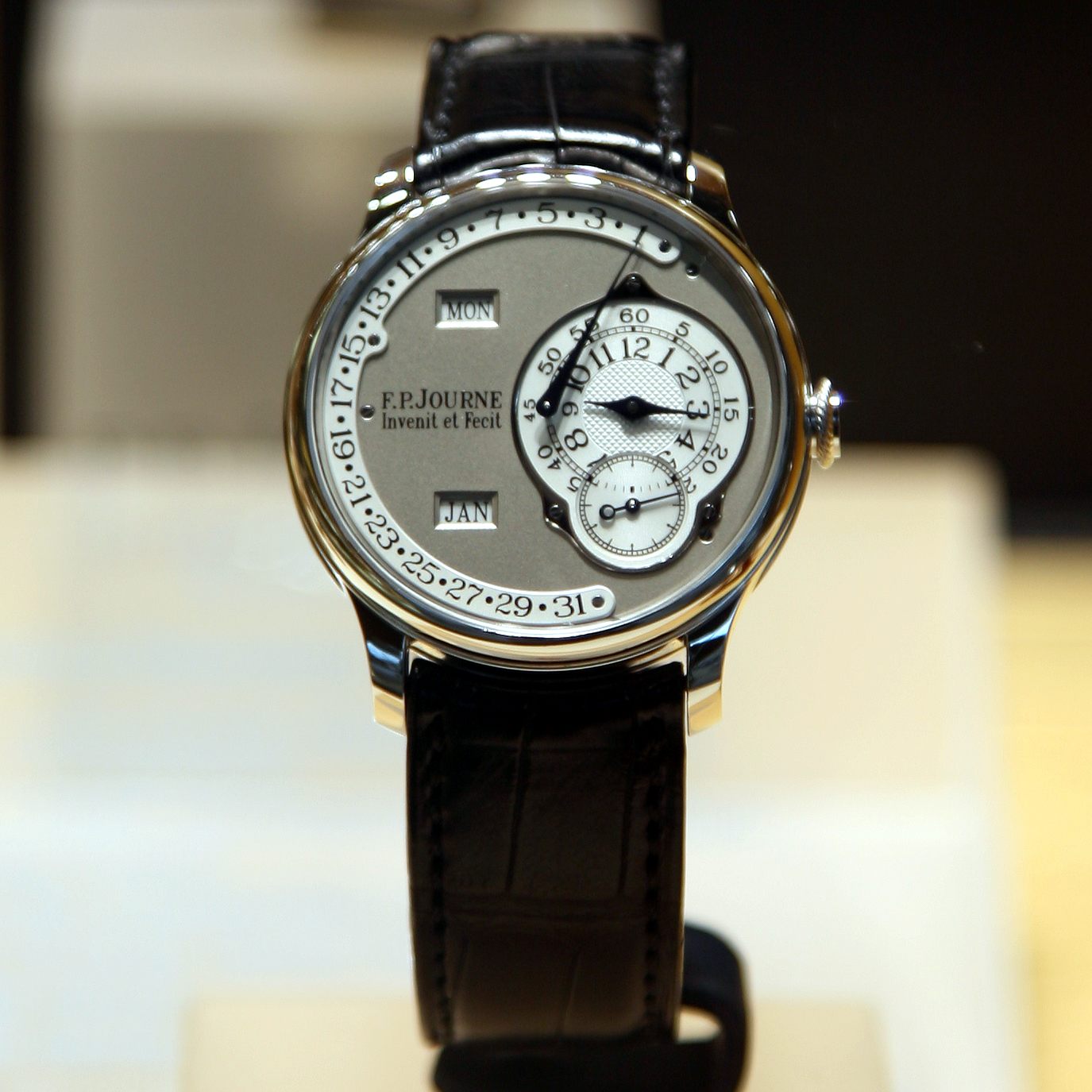
| Octa Automatique Lune (AL) / Automatique Lune (AL2) | AL archive, 2007–2018; later AL2 | Central time display, moon phase, large date and power reserve. AL archive / AL2 specification. |
| Octa UTC | Presented in 2011 | Second-time-zone model on the Octa platform; inspect its specific display and documentation. |
| Divine (DN) | Generation and case size matter | Distinct dial layout; use the Divine guide to identify the watch before selecting comparables. |
| Automatique (AN) | Modern Classique model | Off-center display and enlarged date; current manufacturer options include 40 and 42 mm. Automatique specification. |
| Octa Sport (ARS / ARS2) | First premiere, November 2011; later titanium generations | Central time, day/night indication and sports case. Covered separately in the lineSport guide. |

Five-day autonomy
The Octa calibre: why 120 hours matters
F.P. Journe distinguishes the period of rated precision from the time a fully wound movement may continue to run. The familiar Octa figure is 120 hours of precision. Several manufacturer technical sheets list total autonomy near 160 hours. Those two figures are not competing specifications: running beyond five days does not mean the same precision is promised throughout.
The original calibre uses an off-center rotor and a free-sprung balance. The automatic system was later revised to wind in one direction. That change sought to improve winding for a wearer whose wrist moves little during the day; it does not remove the need to check winding efficiency and reserve on a used example.
| Calibre | Milestone | What to establish on a watch |
|---|---|---|
| 1300 | Original generation, 2001 | Usually rhodium-plated brass in early pieces. Verify the particular watch and service history. |
| 1300.2 | Gold-era change from 2004 | 18k rose-gold plates and bridges; transition periods require reference-level checks. |
| 1300.3 | Revised automatic winding, introduced in 2007 | Later versions vary by model, material and execution. The suffix alone does not identify the case or dial. |
Sources: manufacturer’s 120-hour explanation, F.P. Journal retrospective and 2021 Octa anniversary release. A family relationship is not a claim that every component is interchangeable.
Dial layouts
Octa Lune, Automatique Lune and Automatique
The Octa Lune retains the off-center time display associated with early Octa watches. It adds the moon phase while keeping the date and power-reserve display. The 2003 Men’s Watch Prize belongs to the Octa Lune, not to every later watch carrying the Lune name.
The Automatique Lune moves the hour and minute hands to the center. On AL2, the manufacturer lists small seconds at 4:30, the moon phase, a large date and power reserve at 9 o’clock. Its current case options are 40 or 42 mm. Earlier AL references use a different case generation, so do not transfer dimensions from AL2 to an older listing.
The current Automatique AN returns to an off-center time display without the Lune’s moon phase. This is why “Automatique” alone is not enough to identify a watch. Ask for a straight-on dial photograph, the reference on the documents and a clear movement view before comparing prices.
Compare Lune LN, Automatique Lune AL2 and Automatique AN on the manufacturer’s pages. Case options describe the catalogue, not boutique stock.
Material and originality
Brass or gold: which Octa?
Rhodium-plated brass is associated with the early Octa period; the move to 18k rose-gold movements began in 2004. Treat that as a historical guide, not an automatic authenticity test. The brand’s own brass Calendrier archive extends through 2005, and the 2021 anniversary Automatique deliberately returned to brass.
The 2021 release is a documented exception: 99 platinum watches with calibre 1300.3 in rhodium-plated brass. An aluminum lineSport movement is another legitimate exception to a blanket “all later Journes are gold” rule. The brass versus gold movement guide explains the collecting distinction.
Early brass can attract a premium, but age and movement metal alone do not establish value. Dial originality, case condition, documented service parts and the precise reference matter. A polished case with an unexplained dial change should not be priced as an untouched early example just because its movement is brass.
Black Label is also a specific execution, not a generic name for any black dial. The brand describes a platinum-case collection reserved for existing owners and offered through its boutiques and Espaces. Verify the original configuration and records; a black dial by itself does not prove Black Label provenance.
Primary checks: brass Calendrier archive, 2021 anniversary and Black Label collection.
Dated benchmarks
What is an Octa worth?
Passion Asset Advisory’s historical office benchmark for a standard Octa Lune was about $65,000 to $72,000, reviewed on 12 August 2026. It is not a newly verified transaction range and should not be applied to every Automatique or special-dial Octa.
| Reference group | Historical figure | Evidence limit |
|---|---|---|
| Octa Lune / Automatique Lune retail estimate | $48,000–$52,000 | Office retail estimate, not a current boutique quotation. |
| Standard Octa Lune market benchmark | $65,000–$72,000 | Office estimate, not an identified set of closed sales. Match reference, size, metal and condition. |
| Octa Divine benchmark | $45,000–$70,000 and above | Broad historical guide only; special editions require separate evidence. |
| Early brass, special dials and boutique editions | Individual review | No uniform premium or current public band stated here. |
Source: PAA’s dated price list. This page was published on 27 September 2026; that is not a new review date for these price bands.
A useful valuation names the exact comparables, their dates and the price basis. Dealer advertisements show an asking price; an auction estimate is guidance before a sale; a sold total usually includes a buyer’s premium. None of those amounts automatically equals what an owner receives after fees and costs. See how to obtain a valuation for the evidence to request.
Before a purchase or sale
Five checks for an Octa owner
- Movement and generation. Match the calibre and material to the reference, supported by manufacturer records and any service documentation. Investigate exceptions rather than rejecting a watch from its date alone.
- Case and size. Confirm the measured case, metal and case number. An old guarantee and a later sales listing may describe different dates; keep production, sale and service dates separate.
- Dial and hands. Compare the exact execution, not a similar model. Ask whether any visible parts were replaced in service and whether the replacement is documented.
- Operation. Have a competent watchmaker check automatic winding, rate, reserve and the functions fitted. Do not force a date or moon-phase correction to demonstrate it; follow the correct user manual.
- Documents and ownership. Match numbers on the watch, guarantee and invoices, confirm the seller’s authority, and arrange physical inspection before completion. Photos can screen a watch but cannot establish everything.
Use the 10-point authentication checklist to prepare the inspection file. For a sale, request a written net estimate and route comparison. For a purchase, a private sourcing mandate starts with the exact reference and acceptable condition, not an assumed stock list.
Questions answered
Octa FAQ
How long is the Octa power reserve?
F.P. Journe describes 120 hours of rated precision. Several Octa technical sheets list total autonomy around 160 hours. Continued running beyond five days does not mean the same precision is promised throughout.
Is the Octa still made?
The automatic platform continues in models listed in the Classique and lineSport collections, including Automatique, Automatique Lune and Automatique Réserve. An older reference or execution may be discontinued. Confirm the exact model and availability with a boutique.
What is the difference between Octa Lune and Automatique Lune?
The Lune uses off-center hours and minutes. The Automatique Lune has central hour and minute hands. They also differ by generation and case specification; the name Lune alone is not enough to compare them.
When did F.P. Journe switch from brass to gold movements?
The move began in 2004, but it is not a universal date test. Transitional references need individual checking. The 2021 anniversary Automatique deliberately uses brass, and lineSport includes aluminum movements.
Did the Octa win prizes?
Yes. The Octa Calendrier won the GPHG Special Jury Prize in 2002, and the Octa Lune won the Men’s Watch Prize in 2003.
Is the $65,000 to $72,000 figure a current Octa price?
No. It is PAA’s historical office benchmark for standard Octa Lune examples, reviewed on 12 August 2026. It is not a verified current transaction range for every Octa.
Scope and independence
About this guide
Passion Asset Advisory is a mandate-led private office for collectors selling significant watches, including F.P. Journe; it holds no general dealer inventory, with a disclosed collector-watch principal purchase as the only exception.
Passion Asset Advisory publishes this guide and offers the separate advisory and transaction services linked here. We are not an authorized F.P. Journe dealer and are not affiliated with the manufacturer. Sources appear beside the relevant specifications and price evidence. Historical estimates retain their stated dates; an editorial update does not turn them into current sold prices.
For the wider collection, return to the F.P. Journe collecting guide.
Begin privately
An Octa should be priced by its reference
Keep the reference, case number, service history and set together. We can review a sale route or a separate acquisition mandate, with our role and fees disclosed in writing.